So yeah.. we've been on a long hiatus.
We're back to support HackzFJ and the efforts to expose the apparent ill-gotten and rampant pillaging by this heinous lot.
Jan, 2018
Feb, 2018
March, 2018
April, 2018
May, 2018
- INTELLIGENT RESISTANCE -
Free. Fair. Fearless. Intelligentsiya is made up of Fiji Islanders who are libertarians in their own way and who cherish the free flow of news, ideas and information and will peacefully resist any attempts by the country's military rulers to stifle free speech. intelligentsiya will also bear witness, report and discuss human rights abuses by the authorities.
August 30, 2018
May 24, 2015
Will FICAC Investigate the USP Vice Chancellor or is Political Persecution their only priority?
An email was sent to USP Council Members and various Fiji Government and Opposition members highlighting the concerns of alleged abuse of office, corruption and mismanagement by the Vice Chancellor by "Concerned Pacific Islanders".
It will be very interesting to see whether FICAC will take this up with as much gusto as they have shown for FNU or whether they are content to only carry out Gestapo type political persecution tactics of the Bainimarama Governments bidding.
Moreoever, it will be interesting to see whether key donor countries of the USP Council like Australia and New Zealand are happy to let their taxpayer funds continue pour down the gurgler by Chandra.
The covering note reads:
The summary of the issues raised is reproduced below.
A. Introduction
We as concerned Pacific Islanders who are proud of USP have serious concerns about the future of the University under the leadership of Rajesh Chandra. We know there have been several complaints in the past but these have been conveniently ignored and Rajesh Chandra has been cleared and he got his contract renewed. We also know that the investigations were in-house by the former Chair of Council, Mr. Ikbal Janif who was elected under dubious circumstances and engineered by the VC himself. He only won on a casting vote by the Chair of the Council. Ikbal Janif was also supported by Filipe Bole, Former Minister who is VC Chandra’s good friend and VC Chandra was cleared without any independent investigation. Since then there have been more issues and we cannot ignore this anymore.
Some of us who complained last time by putting our names were sued in the court in Fiji and hence we are not putting our names on this issue. Most of us who complained against harassment continue to face harassment by the hands of the thugs that VC keeps in each section on the university. These thugs have become so brave that they even verbally harass us in corridors and nothing is done about it.
But the issues we want to highlight are more serious and a lot of what was happening has accumulated to a point where it is now a crisis. We humbly request the USP Council and other stakeholders to have an independent investigation at USP.
1. There was much hype about the strategic plan for 2013- 2018 which was used as a transformation document to renew VC Chandra’s contract. A closer look would suggest a big failure. An honest assessment for the last two years- 2013-2014 would suggest that more than 60% of what was to be achieved has not been achieved, for example the STAR review, campus development and appointment of professors etc. An independent audit would spell all this out.
2. STAR project has also been a failure and again the review done by USP through a consultant hired by the VC does not provide a true picture.
3. The ‘good to excellent’ is a dream which will never be realized under the leadership of VC Chandra as espoused in the strategic plan. Leadership of the University at all levels has been wanting and that is why the objectives of the strategic plan will not be realized.
4. There has been lack of leadership at the SMT level and one would have to ask the following questions: Why have so many SMT members left under VC Chandra:
i. Greg Arrowsmith - HR Director – soon after joining USP
ii. Munish Malik - Director Finance - left prematurely
iii. Susan Kelly - Deputy VC - left after dispute. She was paid a large sum by USP as compensation for the left over contract. Susan Kelly’s only fault was that she raised the issue of the murder-suicide of a student (Joytika) and the role of some senior staff who were close buddies of the VC (professor Sudesh Mishra). This matter has only been superficially investigated and swept under the carpet.
iv. Michael Gregory - Pro VC Planning and Quality - left in frustration. In this case VC Chandra committed abuse of office - where he authorized payment including tax paid on his behalf. This issue has also been swept under the carpet as well.
v. Biman Prasad - Dean FBE - Resigned early in his second term. The acting Dean appointed is just a senior lecturer has been there for the last 3 years. VC has not been able to recruit a dean for FBE in the last 3 years.
vi. Heather Stadel - new HR Director left early. No director and hardly any senior staff left.
vii. Professor John Bythell - just left his DVC position. Privately John Bythell was very upset with the dictatorial style of the VC. To cover up, he hurriedly got an old man appointed as Acting DVC for a year and we think the University beached Fiji government immigration policy.
viii. Mr. Adish Naidu - one of the best Director of Physical Planning and Facilities. He was wrongfully suspended. The first preliminary committee did not find anything against him but VC instituted another round of investigation (abuse of power and office) but still could not find anything. Adish Naidu was reinstated but after a while decided to leave the University and we believe a civil court action is underway and University will end up paying him compensation. We here now that VC has forced a appointment of a foreigner who is not even qualified over regional candidates.
ix. We are told that there are serious cracks in the SMT and it is likely that two senior SMT members could leave in frustration sooner than later. One of them is highly qualified regional Vice President from Tonga.
x. The Vice Chancellor has adopted and increasingly dictatorial style of management and in the process has made several blunders and has hidden them from the council. The case of the promotion of Dr. Anjeela Jokhan to Associate Professor is a scandal and has been swept under the carpet. The Vice Chancellor reportedly manipulated the procedure, changed rules and forced his way to promote her despite objection by SMT members like Deputy Vice Chancellor Susan Kelly - who provided a written objection. THIS IS A MAJOR SCANDAL- IN ANY UNIVERSITY THE VICE CHANCELLOR WOULD HAVE BEEN SACKED. (all the papers should be in the HR office)
xi. Apart from SMT members many senior professors have left the University in frustration. Tourism professor, psychology professor, geography professor, mathematics professor, economics head and professor and several others. Officially they will appear like they have normally left but many of them left in frustration. In the strategic plan, the target was to get 60 professors- we hardly have 20 full-time professors in the university and it is almost impossible for the University to recruit more professors in the next few years.
xii. It would be interesting to account for all the reviews that have been undertaken by consultants under VC Chandra. Every time he makes a blunder in a section such as HR, Finance etc. he orders a review and the recommendations of the review are never implemented. Just take the case of the HR section. Since his appointment as VC in 2008 VC Chandra has not been able to sort out that section. Recently he has decided again to review the HR section when many reviews and consultants have already done the review, made money and have left. Donors have happily funded these reviews in good faith but the results have been disappointing.
B. UGC Submission 2016-2018 - LIES AND EXAGGERATION
1. The University Council and stakeholders must scrutinize this document carefully because our analysis shows that it is actually a fraud on the University. Most of the responses are massaged to portray a good picture without any tangible outcomes. In some cases there are outputs but the outcome is still nowhere to be seen. Some key points to note and which needs further clarification and interrogation. They are as follows:
i. The projected surplus of $22.5 million over the next three years is an exaggeration and unachievable.
ii. For example recommendation 2.6 in the last UGC report on campus expansion. The response of the University is somewhat of a lie. The business plans for Kiribati, Solomon Islands, Lautoka and Labasa have all been exaggerated. While Kiribati campus is progressing - it had to go through new requests for funding. Solomon Islands campus site was not properly done and University pushed for an unrealistic location and is shifting the blame on the Solomon Islands Government when it should have known that the location was unrealistic. Lautoka campus land was traded for bigger land but the price for the new one was not negotiated well and USP now finds that the FSC wants a higher price. This project would be dead. So the response of the University to the last UGC recommendation has not been an honest one. This pattern of response is found in all the responses to the last UGC report.
iii. UGC and council members would remember that VC Chandra pushed for government contribution reduction over the last six years, playing politics with the regional governments. Having asked for the reduction in government funding for the last several years- he now comes up with the request that government contribution be increased by 10% for the next three years. This is an absolute blunder. Governments will now be burdened to increase their contribution in a big way. This shows poor planning and management of finances by VC Chandra.
iv. More worrying is his insistence that University could save $15 million dollars over the next three years. This is again exaggerated and design to hoodwink the council members. Our analysis shows that even a $5 million dollar saving in the next three years would be near impossible. In 2014 the surplus was only $300,000 - how he can save $15 million or even $5 million over three years is mindboggling.
v. Careful analysis of the budgets and surpluses for the last several years shows that the University actually misled the council on surpluses, income and expenditure.
vi. There seems to be confusion with the deferred revenue, projects funds and surpluses. These have not been clearly presented.
vii. On the expenditure side, under VC Chandra, expenditure has been poorly managed. Large amounts have been paid as legal fees to lawyers (John Apted, Munro Leys operates from USP), and compensation paid to staff who have taken the University to court - a thorough investigation on this aspect will reveal poor management and leadership.
viii. Several expenditures relating to buildings, repair and maintenance is done without careful planning and there are always over expenditures. Expatriates get the favour from the VC. Recently he has authorized a new flat for an expatriate Vice President as a special favour to him.
Project fund management. The biggest blunder USP made is with respect to the PICPA project and others. PICPA project had a budget of about $45-50 million but lack of leadership by USP and Vice Chancellor saw the Australian government withdrawing most of it (roughly F$40million). It is run by a small complement of staff who does consultancies at high rates and also receive pay. Arvind Patel – who is VC’s favourite (‘it needs to be noted that this academic had sexual, professional harassment cases, he even was investigated by FICAC for taking undeclared cash at the airport. He has never allowed anyone to be appointed/promoted.) His HoS appointment itself is against the staff policy
ix. is now acting Director and we are told – he receives close to $400,000 per year in addition to in-house consultancies he is getting.
x. Payment of inflated salaries to certain favourite staff - Husmuk Lal - Director TVET; Jai Karan, receiving commission we here - Arvind Patel and others who are close to VC.
xi. Engagement of foreign consultants - some of them are known personally to the Vice Chancellor. Some of them are retired people with not much to offer have been hired as consultants in a consistent manner and without any tender process. A fellow from Melbourne, called Frank Larkins travels business class on a regular basis to offer advice and on an astounding daily consultancy package.
xii. Value for money for these consultants is a key question and how much the University has spent on them and what value it has added or how it has led to any tangible benefits.
C. Concluding Comments
The University is at the crossroads. IN MANY WAYS IT HAS REACHED A CRISIS POINT. It could end up being a big failure if the Council and the UGC and governments do not scrutinize the financial, academic and governance aspects of the University. We could be heading towards a sustainable decline of the University. Only and independent inquiry into the operations of the University would bring out the real mismanagement and decline of the university in the last several years.
The council should investigate why the VC has a rule that no staff can take any complaint to the Council level. What if a senior SMT is being discriminated and the VC has an issue. Where does this SMT member go to?
For several years the Vice Chancellor has managed to feed exaggerated outputs and achievements of the University to the council and donors especially Australia and New Zealand. They need to raise some critical questions in an independent manner.
The Council may have been reduced to a rubber stamp by the VC because of the communication and his reporting to the Council based on what he wants from different sections to report.
An independent inquiry is the only way to resolve and find out the extent of the rot in the University.
Fiji government which is a largest contributor to the budget should ask Fiji Independent Commission Against Corruption (FICAC) to investigate the abuse of office by the Vice Chancellor.
The Council must take charge after its meeting in June so that a proper evaluation is taken before the funding commitment for the next 3 years.
It will be very interesting to see whether FICAC will take this up with as much gusto as they have shown for FNU or whether they are content to only carry out Gestapo type political persecution tactics of the Bainimarama Governments bidding.
Moreoever, it will be interesting to see whether key donor countries of the USP Council like Australia and New Zealand are happy to let their taxpayer funds continue pour down the gurgler by Chandra.
The covering note reads:
Dear Council members,
As pacific islanders and stakeholders in the University we are concerned about serious problems of management, abuse of office and deteriorating standards at USP under the leadership of VC Chandra. We have highlighted this before and once again we provide a summary of the problems which is attached. We trust that this time council members would take this seriously and institute at least an independent investigation. We have included in this email the Hon Attorney General of Fiji, the Hon Minister for education of Fiji and PMs office and some key opposition members as Fiji provides the bulk of government grants.
Concerned Pacific Islanders
The summary of the issues raised is reproduced below.
==============================
Corruption, abuse of office, dictatorship and Mismanagement at the University of the South Pacific- under the leadership of Vice Chancellor - Rajesh Chandra
A. Introduction
We as concerned Pacific Islanders who are proud of USP have serious concerns about the future of the University under the leadership of Rajesh Chandra. We know there have been several complaints in the past but these have been conveniently ignored and Rajesh Chandra has been cleared and he got his contract renewed. We also know that the investigations were in-house by the former Chair of Council, Mr. Ikbal Janif who was elected under dubious circumstances and engineered by the VC himself. He only won on a casting vote by the Chair of the Council. Ikbal Janif was also supported by Filipe Bole, Former Minister who is VC Chandra’s good friend and VC Chandra was cleared without any independent investigation. Since then there have been more issues and we cannot ignore this anymore.
Some of us who complained last time by putting our names were sued in the court in Fiji and hence we are not putting our names on this issue. Most of us who complained against harassment continue to face harassment by the hands of the thugs that VC keeps in each section on the university. These thugs have become so brave that they even verbally harass us in corridors and nothing is done about it.
But the issues we want to highlight are more serious and a lot of what was happening has accumulated to a point where it is now a crisis. We humbly request the USP Council and other stakeholders to have an independent investigation at USP.
1. There was much hype about the strategic plan for 2013- 2018 which was used as a transformation document to renew VC Chandra’s contract. A closer look would suggest a big failure. An honest assessment for the last two years- 2013-2014 would suggest that more than 60% of what was to be achieved has not been achieved, for example the STAR review, campus development and appointment of professors etc. An independent audit would spell all this out.
2. STAR project has also been a failure and again the review done by USP through a consultant hired by the VC does not provide a true picture.
3. The ‘good to excellent’ is a dream which will never be realized under the leadership of VC Chandra as espoused in the strategic plan. Leadership of the University at all levels has been wanting and that is why the objectives of the strategic plan will not be realized.
4. There has been lack of leadership at the SMT level and one would have to ask the following questions: Why have so many SMT members left under VC Chandra:
i. Greg Arrowsmith - HR Director – soon after joining USP
ii. Munish Malik - Director Finance - left prematurely
iii. Susan Kelly - Deputy VC - left after dispute. She was paid a large sum by USP as compensation for the left over contract. Susan Kelly’s only fault was that she raised the issue of the murder-suicide of a student (Joytika) and the role of some senior staff who were close buddies of the VC (professor Sudesh Mishra). This matter has only been superficially investigated and swept under the carpet.
iv. Michael Gregory - Pro VC Planning and Quality - left in frustration. In this case VC Chandra committed abuse of office - where he authorized payment including tax paid on his behalf. This issue has also been swept under the carpet as well.
v. Biman Prasad - Dean FBE - Resigned early in his second term. The acting Dean appointed is just a senior lecturer has been there for the last 3 years. VC has not been able to recruit a dean for FBE in the last 3 years.
vi. Heather Stadel - new HR Director left early. No director and hardly any senior staff left.
vii. Professor John Bythell - just left his DVC position. Privately John Bythell was very upset with the dictatorial style of the VC. To cover up, he hurriedly got an old man appointed as Acting DVC for a year and we think the University beached Fiji government immigration policy.
viii. Mr. Adish Naidu - one of the best Director of Physical Planning and Facilities. He was wrongfully suspended. The first preliminary committee did not find anything against him but VC instituted another round of investigation (abuse of power and office) but still could not find anything. Adish Naidu was reinstated but after a while decided to leave the University and we believe a civil court action is underway and University will end up paying him compensation. We here now that VC has forced a appointment of a foreigner who is not even qualified over regional candidates.
ix. We are told that there are serious cracks in the SMT and it is likely that two senior SMT members could leave in frustration sooner than later. One of them is highly qualified regional Vice President from Tonga.
x. The Vice Chancellor has adopted and increasingly dictatorial style of management and in the process has made several blunders and has hidden them from the council. The case of the promotion of Dr. Anjeela Jokhan to Associate Professor is a scandal and has been swept under the carpet. The Vice Chancellor reportedly manipulated the procedure, changed rules and forced his way to promote her despite objection by SMT members like Deputy Vice Chancellor Susan Kelly - who provided a written objection. THIS IS A MAJOR SCANDAL- IN ANY UNIVERSITY THE VICE CHANCELLOR WOULD HAVE BEEN SACKED. (all the papers should be in the HR office)
xi. Apart from SMT members many senior professors have left the University in frustration. Tourism professor, psychology professor, geography professor, mathematics professor, economics head and professor and several others. Officially they will appear like they have normally left but many of them left in frustration. In the strategic plan, the target was to get 60 professors- we hardly have 20 full-time professors in the university and it is almost impossible for the University to recruit more professors in the next few years.
xii. It would be interesting to account for all the reviews that have been undertaken by consultants under VC Chandra. Every time he makes a blunder in a section such as HR, Finance etc. he orders a review and the recommendations of the review are never implemented. Just take the case of the HR section. Since his appointment as VC in 2008 VC Chandra has not been able to sort out that section. Recently he has decided again to review the HR section when many reviews and consultants have already done the review, made money and have left. Donors have happily funded these reviews in good faith but the results have been disappointing.
B. UGC Submission 2016-2018 - LIES AND EXAGGERATION
1. The University Council and stakeholders must scrutinize this document carefully because our analysis shows that it is actually a fraud on the University. Most of the responses are massaged to portray a good picture without any tangible outcomes. In some cases there are outputs but the outcome is still nowhere to be seen. Some key points to note and which needs further clarification and interrogation. They are as follows:
i. The projected surplus of $22.5 million over the next three years is an exaggeration and unachievable.
ii. For example recommendation 2.6 in the last UGC report on campus expansion. The response of the University is somewhat of a lie. The business plans for Kiribati, Solomon Islands, Lautoka and Labasa have all been exaggerated. While Kiribati campus is progressing - it had to go through new requests for funding. Solomon Islands campus site was not properly done and University pushed for an unrealistic location and is shifting the blame on the Solomon Islands Government when it should have known that the location was unrealistic. Lautoka campus land was traded for bigger land but the price for the new one was not negotiated well and USP now finds that the FSC wants a higher price. This project would be dead. So the response of the University to the last UGC recommendation has not been an honest one. This pattern of response is found in all the responses to the last UGC report.
iii. UGC and council members would remember that VC Chandra pushed for government contribution reduction over the last six years, playing politics with the regional governments. Having asked for the reduction in government funding for the last several years- he now comes up with the request that government contribution be increased by 10% for the next three years. This is an absolute blunder. Governments will now be burdened to increase their contribution in a big way. This shows poor planning and management of finances by VC Chandra.
iv. More worrying is his insistence that University could save $15 million dollars over the next three years. This is again exaggerated and design to hoodwink the council members. Our analysis shows that even a $5 million dollar saving in the next three years would be near impossible. In 2014 the surplus was only $300,000 - how he can save $15 million or even $5 million over three years is mindboggling.
v. Careful analysis of the budgets and surpluses for the last several years shows that the University actually misled the council on surpluses, income and expenditure.
vi. There seems to be confusion with the deferred revenue, projects funds and surpluses. These have not been clearly presented.
vii. On the expenditure side, under VC Chandra, expenditure has been poorly managed. Large amounts have been paid as legal fees to lawyers (John Apted, Munro Leys operates from USP), and compensation paid to staff who have taken the University to court - a thorough investigation on this aspect will reveal poor management and leadership.
viii. Several expenditures relating to buildings, repair and maintenance is done without careful planning and there are always over expenditures. Expatriates get the favour from the VC. Recently he has authorized a new flat for an expatriate Vice President as a special favour to him.
Project fund management. The biggest blunder USP made is with respect to the PICPA project and others. PICPA project had a budget of about $45-50 million but lack of leadership by USP and Vice Chancellor saw the Australian government withdrawing most of it (roughly F$40million). It is run by a small complement of staff who does consultancies at high rates and also receive pay. Arvind Patel – who is VC’s favourite (‘it needs to be noted that this academic had sexual, professional harassment cases, he even was investigated by FICAC for taking undeclared cash at the airport. He has never allowed anyone to be appointed/promoted.) His HoS appointment itself is against the staff policy
ix. is now acting Director and we are told – he receives close to $400,000 per year in addition to in-house consultancies he is getting.
x. Payment of inflated salaries to certain favourite staff - Husmuk Lal - Director TVET; Jai Karan, receiving commission we here - Arvind Patel and others who are close to VC.
xi. Engagement of foreign consultants - some of them are known personally to the Vice Chancellor. Some of them are retired people with not much to offer have been hired as consultants in a consistent manner and without any tender process. A fellow from Melbourne, called Frank Larkins travels business class on a regular basis to offer advice and on an astounding daily consultancy package.
xii. Value for money for these consultants is a key question and how much the University has spent on them and what value it has added or how it has led to any tangible benefits.
C. Concluding Comments
The University is at the crossroads. IN MANY WAYS IT HAS REACHED A CRISIS POINT. It could end up being a big failure if the Council and the UGC and governments do not scrutinize the financial, academic and governance aspects of the University. We could be heading towards a sustainable decline of the University. Only and independent inquiry into the operations of the University would bring out the real mismanagement and decline of the university in the last several years.
The council should investigate why the VC has a rule that no staff can take any complaint to the Council level. What if a senior SMT is being discriminated and the VC has an issue. Where does this SMT member go to?
For several years the Vice Chancellor has managed to feed exaggerated outputs and achievements of the University to the council and donors especially Australia and New Zealand. They need to raise some critical questions in an independent manner.
The Council may have been reduced to a rubber stamp by the VC because of the communication and his reporting to the Council based on what he wants from different sections to report.
An independent inquiry is the only way to resolve and find out the extent of the rot in the University.
Fiji government which is a largest contributor to the budget should ask Fiji Independent Commission Against Corruption (FICAC) to investigate the abuse of office by the Vice Chancellor.
The Council must take charge after its meeting in June so that a proper evaluation is taken before the funding commitment for the next 3 years.
April 15, 2015
January 17, 2015
From the Archives: Green Moon Rising: Islam Is Spreading In Melanesia (Pacific Magazine 2007)
Pacific Magazine > Magazine > June 29, 2007
Cover Story
Green Moon Rising
Islam Is Spreading In Melanesia
By Words and Photos by Ben Bohane, Port Vila
http://www.pacificmagazine.net/issue/2007/06/29/green-moon-rising
Much of the funding for the Hohola mosque in Port Moresby comes from Malaysian and Saudi sources.
For Mohammed “Sambo” Seddiq, a Ni-Vanuatu Muslim who provided land and a small building that houses Vanuatu’s first mosque, conversion to Islam didn’t happen overnight.
Sitting on a prayer mat inside the green-painted house in Mele village that from the exterior looks like any other house in the community, Seddiq tells me it was a process that happened over many years, beginning with a sense of curiosity, until he felt that “Allah had truly called me” and it was time to change his life.
“I was a Pentecostal Christian before, with the Neil Thomas Mission, but I didn’t feel in control of my life and I had a problem with alcohol,” he says openly. “Islam is straight forward and disciplined and this is what I needed to be a better person in the eyes of Allah. You know, the Bible is only full of stories, but I found that the Qur’an gives direction to life.”
He was first exposed to the faith when one of his relatives, John Henry Nabanga, had returned from India in 1978 where he had been sent for Bible studies and scriptural translations but instead came home converted to Islam.
Seddiq watched how Islam had transformed John “Hussein” Nabanga into an honorable and generous man and the way his extended family began to embrace it through his personal example. In 1992, the Mele mosque was opened and each Friday since then, the dozen or two local Muslims who live in the capital Port Vila can be found at prayers in the stark room, unadorned except for a curtain screening off the women and a large clock with a picture of Mecca on it.
Today, there are between 100 and 200 ni-Vanuatu converts to Islam. Mosques are now springing up in the outer islands of the archipelago, such as in the islands of Malekula and Tanna. Chiefs are often the target of proselytizing efforts on the often correct assumption that if they convert then their extended families, clans and other islanders will also likely convert.
Of course, it is not just Vanuatu witnessing the phenomenon — throughout the Pacific Islands, Islam is on the rise and an umma (Islamic community) is being established in every country of the region.
Islam is the world’s fastest growing religion and the Pacific is proving no exception: indeed it seems to be actively targeted by Malaysian and Saudi-funded organizations, with oversight coming from within the established umma in Australia, New Zealand and Fiji. In many instances, African Muslim missionaries are being deployed in the belief that Pacific Islanders will naturally respond better to the efforts of fellow black missionaries.
Nowhere is the growth of Islam more palpable than in Melanesia, which has a culture of religious dynamism and experimentation, where kastom, cargo cult and Christian movements continue to evolve, blend, mutate, syncretise and spawn new belief systems. Now Islam can be added to the mix and its effect on traditional kastom, national politics and regional security can no longer be overlooked.
Although there are no official figures and few academic studies, it is believed there has been thousands of indigenous converts to Islam in recent years in Papua New Guinea, Solomon Islands, Vanuatu and Fiji alone. New Caledonia also has a large, but unknown number of Muslims who have settled there from all over the Francophone world over the past 100 years.
It was while cruising PNG’s rugged highlands highway two years ago and noticing the increasing number of bush mosques springing up, that first prompted me to ask: why is Islam becoming a serious religious alternative for Pacific Islanders?
My first instinct was to dismiss it, thinking: “nah — Islam is never going to take hold in a region which is based on pig culture.” But perhaps I’m wrong.
There are indeed cultural parallels. First among these may be the fact that Islam developed from a tribal Arabic culture also and maintains decision-making bodies (shurias) that are similar, in their social organization and un-hierarchical nature, to Melanesian chiefly councils.
The notion of “payback” is one that resonates strongly in both Melanesian and Islamic tradition, ie the notion of “eye for an eye.” Although Christian influence is strong, Jesus’ example of “turning the other cheek” has not, it must be said, been largely adopted by Melanesians.
One of the widespread frustrations among islanders to Western law stems from the fact that Western law does not compensate the victim, unlike traditional Melanesian and Islamic law. Polygamy and gender separation (such as Men’s Houses and Women’s Houses in Melanesia) are part of both Pacific and Islamic culture. Seddiq in Vanuatu even suggests that since his people traditionally sat on mats on the floor, mosques feel more natural to them than sitting in Church pews.
Part of the problem Western observers have in understanding the region is that they tend to have a secular outlook and place primacy of their analysis on the role of the State (issues of good governance, corruption, service delivery, unemployment etc) when in fact the world view of Melanesians today is virtually the opposite – their daily lives remain governed by kastom and religious obligations and subsistence agriculture. They place little emphasis on the role of the State since it is an introduced concept, heavily centralized in the capital cities and usually has little impact on the daily lives of islanders living in rural and remote areas.
Scott Flower, a PhD student at the Crawford School of Pacific Policy at the Australian National University in Canberra, is one of the few to take the growth of Islam in Melanesia seriously, with a regional view.
“Melanesian people generally do not comprehend or desire the separation of religion and the State. The centrality of religion in their daily life is very important,” he says, suggesting an inherent feeling towards living in a theocratic State; whether it is in kastom, Christianity or Islam.
Flower argues that Muslim communities in each country will continue to grow in size and number because, like Christianity, Islam and its associated organizations provide islanders with public goods (such as health and education), a moral and spiritual system, and access to other global networks and opportunities, prestige and alternative paths to social and political power.
“In general, conversions from traditional religions to Christianity in Melanesia were not only for theological and spiritual reasons but for practical purposes as well. It is unlikely that the attraction to Islam in this way will be any different,” he says.
Already, an Islamic school in Oro province in PNG is attracting children from neighboring villages happy for any schooling.
I have met families from poor squatter settlements in Port Moresby, Port Vila and other urban centers who are sending their children away to madrassas (Islamic schools) overseas in Malaysia, Yemen, Fiji, and Saudi Arabia “because they will have better opportunities there,” they tell me.
When the deadly Solomons tsunami crashed through Gizo and Western Province killing 53 people and displacing thousands of villagers, the international Muslim Aid organization quickly dispatched medical teams and supplies for the affected areas and islanders embraced this aid as much as any other. It is believed to be the first time a major Islamic charity has offered assistance to a Pacific country following a natural disaster.
The process to become a Muslim is in itself simple, compared to other faiths: one needs only to have made the decision definitively in your mind and recite the basic tenet of the faith three times (“There is no God but Allah and Mohammed is His prophet”), in the company of fellow Muslims, to be accepted into the faith.
Foreign and local missionaries alike often suggest that what they offer is not conversion, but reversion–that is, by embracing Islam islanders are reverting back to kastom and ancestral ways. It is clever marketing, but slightly disingenuous. When I discussed this notion with Seddiq in Vanuatu and Yaqub Amaki from the PNG Muslim Association at the Hohola mosque in Port Moresby, both conceded that eventually Islam has primacy and there was little kastom that would survive.
The foundations of much Melanesian kastom relating to pigs, beetlenut chewing, kava drinking, ancestral worship as well as dancing related to courtship or ancestral/ nature worship is not halal ( therefore tabu) for those who truly embrace Islam. This prompts the question: what kastom is left? Can Pacific kastom find a place within orthodox Islamic interpretation?
This question goes to the heart of one of the central questions facing Islam globally–how can Islam separate its faith and philosophy from Arabic cultural practices?
Those interested in preserving Melanesian kastom see Islam as potentially a damaging cultural force, rather than a security one. Professor Kirk Hoffman, one of the founders of the Vanuatu Cultural Centre puts it bluntly: “The growth of Islam will destroy Melanesian kastom in perhaps the same way that strict Christian missionaries did 100 or 200 years ago.”
There is also the issue of Pacific Islanders not being fully aware of the whole breadth and range of Islam to choose from, from the very tolerant, mystical Sufi tradition, to orthodox Sunni and Shia beliefs, to militant *******-ism, to explicitly non-violent sects of Islam such as the Ahmadiyyah, founded in 1889, who believe “there can only ever be a jihad of the heart” and who are deemed heretical by other Muslims for believing that a Sufi-inspired Indian prophet named Mirza Ghulam Ahmad was “the last prophet,” not Mohammed.
Often persecuted in their own Muslim countries, some of Ahmadiyyah’s 100 million followers worldwide are ironically seeking sanctuary in Christian countries, including the Pacific. There is already a strong community in Kimbe, PNG and in Guadalcanal, Solomon Islands. Unlike other Islamic groups, the Ahmadiyyah seem much more transparent with their activities, with information on its Australian and Pacific activities available on its website www.ahmadiyya.org.au.
Given that Islam is on the rise anyway, perhaps it is in the interests of Pacific governments to actively encourage the input of non-violent Islamic groups like the Ahmadiyyas in their local Muslim communities as one of the seeds of Pacific Islam.
Islam can offer a range of benefits to island communities in terms of local service delivery and access to global finance for development (through such organizations as the Islamic Development Bank).
As the Islamic world comes in contact with Pacific culture, so too is it important for Pacific island communities to have a better understanding of the range of Islam—particularly those drawn to the faith—and the likely impact it will have on their societies. Seddiq in the Mele mosque points out that in Vanuatu, unlike other Pacific Islands, Islam was established by “its own sons,” not foreign missionaries, so that it will always maintain a local flavor.
“Islam here is homegrown, so we can control it. Other countries have foreign missionaries but what happens when they leave? Better that we send our children overseas to study and come back with good degrees than having to rely on overseas missionaries coming here.”
Right now, 28 Muslims from Vanuatu are studying in Islamic colleges overseas: in Fiji, Malaysia, New Zealand, Saudi Arabia, Iran and Pakistan. Given that it is the smallest country in Melanesia, it is likely that at any one time hundreds of Pacific Muslims are studying overseas in madrassas throughout the Islamic world.
Already a debate is well underway at the Hohola mosque in PNG’s capital Port Moresby on what kind of Islam is most suitable for this part of the world.
Regular inter-faith dialogues with members of PNG’s Roman Catholic, Anglican, Bahai and Buddhist clergy are also a cause for optimism that dialogue is in progress and communal tensions can be kept in check.
One rainy Friday I attended prayers at the Hohola mosque and was welcomed in with all the hospitality that Muslims are famous for.
The Imam, brother Mikail Abdul Aziz from Nigeria, was away, so I met the acting Imam, Khaled, a Bougainvillean who is the most senior Papua New Guinean Muslim. Khaled comes across as thoughtful and easy-going. He jokes about how his wife has remained a committed Christian who occasionally likes to argue with him on religious matters, but that ultimately it has not affected their personal relationship…why shouldn’t that be something of a metaphor for the wider community, he seems to imply?
Given that much of the funding for the Hohola mosque has come from Saudi and Malaysian sources, that its’ Imam is a Nigerian steeped in *******-ism, (the most puritanical of Muslim ideology which Osama bin Laden also subscribes to) and that all copies of the Holy Qur’an on their shelf have been printed in Saudi Arabia and follow *******-ist interpretations…I feel compelled to ask if this is the most appropriate form of Islam for PNG and the region?
Yaqub Amaki, a Sepik River man who is General Secretary for the PNG Muslim Association replies: “I can say that we have already had some very robust discussions on this issue. Some of us think that a more moderate interpretation, found in countries like Malaysia and Indonesia, will be more appropriate for the umma here. We are still finding our way here and while there are no real divisions in Islam, there are different paths and we need to be open to debate.
“Since the Saudis and Malaysians were here in the beginning to assist us, it is only natural that we should follow their lead, but I am confident that Islam here will gradually take on a more PNG style over time.”
The question of funding for Islam in Australia and the Pacific has become a prickly one at times. In January this year a minor spat broke out between the Australian government and the Saudi government following claims that the Saudi Embassy in Canberra was funding unidentified Islamic groups to pay wages for at least 20 Imams in mosques around Australia.
The Saudi government refused to identify the groups and Canberra disputed claims that all the recipients getting Saudi cash had been vetted by Australia’s Foreign Affairs and Trade, as is required.
Numerous Pacific Island Muslims I have spoken to have said that they receive financial support and other assistance from the Saudi Embassy in Canberra, believing that the mission has diplomatic responsibility and religious oversight for the Pacific Islands as well. Saudi diplomats have visited numerous Pacific Island communities and help channel scholarship funds for students who want to study abroad, often with the assistance of the Islamic Development Bank.
Pacific Magazine approached an information officer at the Saudi Embassy in Canberra recently to ask for an official outline of its assistance to Pacific Island communities, but was told flatly, “the Saudi Government does not provide any help to the Pacific Islands – go and talk to the Malaysians and Indonesians. Further questions were not responded to. Although the range of assistance is likely to be for non-controversial purposes such as mosque-building and education in the islands, it is this lack of transparency that concerns some observers.
Meanwhile a Pacific Imam training course is available for Australians and Pacific Islanders to undergo at the Islamic University in Kuala Lumpur, Malaysia. A Malaysian organization called RISEAP (Regional Islamic Da’wah Council of South East Asia and the Pacific) has already funded dozens, maybe hundreds, of Pacific Island Muslims to do the intensive three-month course there.
Whether Malaysia and Saudi Arabia are in competition for the souls of Pacific Islander Muslims, or are actually working together in co-ordination is hard to tell at this stage.
The Security Question
While Islam is being quietly and peacefully absorbed into central and eastern Melanesian nations and most parts of the Pacific, the same cannot be said for those in western Melanesia, particularly those under Indonesian control. Here, jihadi groups flourish and sectarian conflict periodically explodes, such as in Ambon and the Molluku islands, where more than 10,000 people died in sectarian conflict between Christians and Muslims in the late 1990s. Locals accuse sections of the Indonesian military of deliberately sparking the conflict in a divide and rule tactic, afraid the once-united community of these islands wanted to break-away from Indonesia after the fall of Suharto.
In West Papua, the OPM (Free West Papua Movement) has for years warned that militant groups such as JI and Laskar Jihad are operating there to suppress the independence movement as well as springboarding across unpatrolled borders into neighboring PNG, Australia and other Pacific Islands.
OPM Commander John Koknak claims there are more than a dozen jihad training camps across West Papua, many of them close the border with PNG and Australia.
An increasing number of bush mosques have sprouted in Papua New Guinea’s highlands region in recent years.
“I have been warning Australia and PNG for some time, but they prefer to trust the Generals in Jakarta” Koknak told me from his base in PNG. “You know, militant Islam in the Pacific is nothing new: JI is using the same networks as the Libyan Mataban groups who came here in the 1980s to set up cells and support Pacific liberation groups.”
Commander Koknak’s assessment is supported by “Robert,” a Papua New Guinean Defense Force intelligence operative with responsibility for PNG’s border, who complained to me recently that infiltration by militant groups and people smugglers is going on regularly across PNG’s unmonitored 800km border with Indonesia, which he described as “the gateway for terrorists into the Pacific.”
“The Australians and Americans keep focusing on Iraq and Afghanistan, but they should be concentrating on their own backyard here in the Pacific instead.” Other Pacific leaders are more skeptical of the threat of terrorism, like former Prime Minister of the Cook Islands, Sir Geoffrey Henry.
“Terrorism is not part of our world, it doesn’t matter what anybody else says,” Sir Geoffrey told ABC radio in a 2003 interview, complaining that a regional police conference had taken the threat of terrorism as its top theme that year.
“They’re all wrong. The fact of the matter is we are free of terrorism.”
If we discount the sectarian fighting in the Melanesian territories of Indonesia, it is true that the Pacific has so far not witnessed any Islamic-inspired terrorist incidents and local Islamic communities in the Pacific generally live in peace within the broader community. All Pacific nations have enshrined “freedom of religion” within their Constitutions.
But that has not stopped periodic alerts and the possibility of small Pacific states acting as unwitting springboards for militant Islamic groups.
Two of the September 11 hijackers lived in Fiji for several months immediately prior to flying on to U.S. for their mission.
In August 2002 American Samoa put a blanket ban on visits by Muslim visitors from 23 countries, following the closure of the American consulate there because of a terrorist threat. Apparently two unidentified men “of Middle Eastern appearance” had been seen photographing the consulate and concerns were raised about the visit by Sheik Abdul Majid, director of the Islamic Institute of the South Pacific (based in the Fijian capital Suva) along with a Saudi official from the Ministry of Tourism and Culture. Sheik Majid claimed the visit was part of a tour of Islamic communities in the Pacific, but soon after, in February 2003 the Sudanese-born cleric was expelled from Fiji on the grounds that he was a security threat.
The Islamic Human Rights Commission had also raised concern for the umma in PNG, following an arsonist attack on the main mosque in Port Moresby in November 2002. The attack may have been inspired by comments made by PNG’s then Deputy Prime Minister that PNG’s Constitution should be changed to allow for the banning of “violent religions,” which many took as a reference to Islam. Muslims have also been periodically attacked in the highlands of PNG, including one incident in Mt Hagen when a mob turned on a group of local and foreign Muslims, which required police to intervene and fire shots into the air before escorting the Muslims to their homes in neighboring Chimbu province.
In the Solomon Islands, Radio SIBC reported in July 2005 claims made by the countries’ Finance Minister Peter Boyers, that Islamic militants from Indonesia had tried recruiting young Solomon Islanders for training camps in Indonesia.
The Minister said that Solomon Islands Muslim groups were against radical Islam and refused the request, something supported by Felix Narasia of the Islamic Society of Solomon Islands. Narasia said the Islamic Society denounces any recruitment of Solomon Island youth for such purposes, saying such contacts were “illegal” and outside the Islamic
Society of Solomon Islands.
Then late last year came the intriguing story of Wolfgang Bohringer and his Slovenian girlfriend, who sailed into Kiribati’s Fanning island in 2005 to set up a flight training school on this remote island close to U.S. territory.
Suspicions arose over his motives, prompting Kiribati officials and the FBI to investigate, but when Bohringer got wind of it, he sailed off, leaving his girlfriend behind.
How worried should we be about Islamic terrorism in the Pacific? Scott Flower at the ANU: “While the more alarmist government and media scenarios of terrorist threats in the Pacific are undoubtedly inflated, the other perspective of a completely benign security environment is also likely to be incorrect.”
While there have been some assessments done on threats to Australia and the U.S. from the region, Flower points out how little study has been done on the potential for domestic conflict within Melanesia as Islam grows. He warns of Muslim groups taking security into their own hands if they face repeated persecution in PNG, particularly in the volatile highlands.
In the Solomons, a situation has developed where the Ahmadiyyas have focused their proselytizing efforts on Guadalcanal island while orthodox Sunni organizations have targeted Malaita islanders. Several former Malaitan Eagle Force militants have reportedly converted to Islam and there is a danger that the on-going ethnic tension between Guadalcanal and Malaita (which caused civil war in the late 1990s and prompted the Australian-led RAMSI intervention) could become exacerbated by religious differences, too.
Clearly there are some warning signs there, but any threats to the Pacific are more likely to come from foreign militants using the cover of local Islamic communities, rather than from indigenous Pacific Muslims themselves. As these local Muslim communities grow, it will be in their interests to identify those among them who are straying from Mohammed’s message of peace, and to “out” militants among them whose actions will only rebound badly on local communities.
Regional Pacific and Australian governments also need to become more nuanced in their approach to dealing with Islam and to better understand the link between conflict and kastom, cargo cult and new religious movements generally, in Melanesia. Too much emphasis on “the State” and not enough on understanding the complex daily spirit worlds of Pacific Islanders risks misunderstanding their real hopes and aspirations.
Cover Story
Green Moon Rising
Islam Is Spreading In Melanesia
By Words and Photos by Ben Bohane, Port Vila
http://www.pacificmagazine.net/issue/2007/06/29/green-moon-rising
Much of the funding for the Hohola mosque in Port Moresby comes from Malaysian and Saudi sources.
For Mohammed “Sambo” Seddiq, a Ni-Vanuatu Muslim who provided land and a small building that houses Vanuatu’s first mosque, conversion to Islam didn’t happen overnight.
Sitting on a prayer mat inside the green-painted house in Mele village that from the exterior looks like any other house in the community, Seddiq tells me it was a process that happened over many years, beginning with a sense of curiosity, until he felt that “Allah had truly called me” and it was time to change his life.
“I was a Pentecostal Christian before, with the Neil Thomas Mission, but I didn’t feel in control of my life and I had a problem with alcohol,” he says openly. “Islam is straight forward and disciplined and this is what I needed to be a better person in the eyes of Allah. You know, the Bible is only full of stories, but I found that the Qur’an gives direction to life.”
He was first exposed to the faith when one of his relatives, John Henry Nabanga, had returned from India in 1978 where he had been sent for Bible studies and scriptural translations but instead came home converted to Islam.
Seddiq watched how Islam had transformed John “Hussein” Nabanga into an honorable and generous man and the way his extended family began to embrace it through his personal example. In 1992, the Mele mosque was opened and each Friday since then, the dozen or two local Muslims who live in the capital Port Vila can be found at prayers in the stark room, unadorned except for a curtain screening off the women and a large clock with a picture of Mecca on it.
Today, there are between 100 and 200 ni-Vanuatu converts to Islam. Mosques are now springing up in the outer islands of the archipelago, such as in the islands of Malekula and Tanna. Chiefs are often the target of proselytizing efforts on the often correct assumption that if they convert then their extended families, clans and other islanders will also likely convert.
Of course, it is not just Vanuatu witnessing the phenomenon — throughout the Pacific Islands, Islam is on the rise and an umma (Islamic community) is being established in every country of the region.
Islam is the world’s fastest growing religion and the Pacific is proving no exception: indeed it seems to be actively targeted by Malaysian and Saudi-funded organizations, with oversight coming from within the established umma in Australia, New Zealand and Fiji. In many instances, African Muslim missionaries are being deployed in the belief that Pacific Islanders will naturally respond better to the efforts of fellow black missionaries.
Nowhere is the growth of Islam more palpable than in Melanesia, which has a culture of religious dynamism and experimentation, where kastom, cargo cult and Christian movements continue to evolve, blend, mutate, syncretise and spawn new belief systems. Now Islam can be added to the mix and its effect on traditional kastom, national politics and regional security can no longer be overlooked.
Although there are no official figures and few academic studies, it is believed there has been thousands of indigenous converts to Islam in recent years in Papua New Guinea, Solomon Islands, Vanuatu and Fiji alone. New Caledonia also has a large, but unknown number of Muslims who have settled there from all over the Francophone world over the past 100 years.
It was while cruising PNG’s rugged highlands highway two years ago and noticing the increasing number of bush mosques springing up, that first prompted me to ask: why is Islam becoming a serious religious alternative for Pacific Islanders?
My first instinct was to dismiss it, thinking: “nah — Islam is never going to take hold in a region which is based on pig culture.” But perhaps I’m wrong.
There are indeed cultural parallels. First among these may be the fact that Islam developed from a tribal Arabic culture also and maintains decision-making bodies (shurias) that are similar, in their social organization and un-hierarchical nature, to Melanesian chiefly councils.
The notion of “payback” is one that resonates strongly in both Melanesian and Islamic tradition, ie the notion of “eye for an eye.” Although Christian influence is strong, Jesus’ example of “turning the other cheek” has not, it must be said, been largely adopted by Melanesians.
One of the widespread frustrations among islanders to Western law stems from the fact that Western law does not compensate the victim, unlike traditional Melanesian and Islamic law. Polygamy and gender separation (such as Men’s Houses and Women’s Houses in Melanesia) are part of both Pacific and Islamic culture. Seddiq in Vanuatu even suggests that since his people traditionally sat on mats on the floor, mosques feel more natural to them than sitting in Church pews.
Part of the problem Western observers have in understanding the region is that they tend to have a secular outlook and place primacy of their analysis on the role of the State (issues of good governance, corruption, service delivery, unemployment etc) when in fact the world view of Melanesians today is virtually the opposite – their daily lives remain governed by kastom and religious obligations and subsistence agriculture. They place little emphasis on the role of the State since it is an introduced concept, heavily centralized in the capital cities and usually has little impact on the daily lives of islanders living in rural and remote areas.
Scott Flower, a PhD student at the Crawford School of Pacific Policy at the Australian National University in Canberra, is one of the few to take the growth of Islam in Melanesia seriously, with a regional view.
“Melanesian people generally do not comprehend or desire the separation of religion and the State. The centrality of religion in their daily life is very important,” he says, suggesting an inherent feeling towards living in a theocratic State; whether it is in kastom, Christianity or Islam.
Flower argues that Muslim communities in each country will continue to grow in size and number because, like Christianity, Islam and its associated organizations provide islanders with public goods (such as health and education), a moral and spiritual system, and access to other global networks and opportunities, prestige and alternative paths to social and political power.
“In general, conversions from traditional religions to Christianity in Melanesia were not only for theological and spiritual reasons but for practical purposes as well. It is unlikely that the attraction to Islam in this way will be any different,” he says.
Already, an Islamic school in Oro province in PNG is attracting children from neighboring villages happy for any schooling.
I have met families from poor squatter settlements in Port Moresby, Port Vila and other urban centers who are sending their children away to madrassas (Islamic schools) overseas in Malaysia, Yemen, Fiji, and Saudi Arabia “because they will have better opportunities there,” they tell me.
When the deadly Solomons tsunami crashed through Gizo and Western Province killing 53 people and displacing thousands of villagers, the international Muslim Aid organization quickly dispatched medical teams and supplies for the affected areas and islanders embraced this aid as much as any other. It is believed to be the first time a major Islamic charity has offered assistance to a Pacific country following a natural disaster.
The process to become a Muslim is in itself simple, compared to other faiths: one needs only to have made the decision definitively in your mind and recite the basic tenet of the faith three times (“There is no God but Allah and Mohammed is His prophet”), in the company of fellow Muslims, to be accepted into the faith.
Foreign and local missionaries alike often suggest that what they offer is not conversion, but reversion–that is, by embracing Islam islanders are reverting back to kastom and ancestral ways. It is clever marketing, but slightly disingenuous. When I discussed this notion with Seddiq in Vanuatu and Yaqub Amaki from the PNG Muslim Association at the Hohola mosque in Port Moresby, both conceded that eventually Islam has primacy and there was little kastom that would survive.
The foundations of much Melanesian kastom relating to pigs, beetlenut chewing, kava drinking, ancestral worship as well as dancing related to courtship or ancestral/ nature worship is not halal ( therefore tabu) for those who truly embrace Islam. This prompts the question: what kastom is left? Can Pacific kastom find a place within orthodox Islamic interpretation?
This question goes to the heart of one of the central questions facing Islam globally–how can Islam separate its faith and philosophy from Arabic cultural practices?
Those interested in preserving Melanesian kastom see Islam as potentially a damaging cultural force, rather than a security one. Professor Kirk Hoffman, one of the founders of the Vanuatu Cultural Centre puts it bluntly: “The growth of Islam will destroy Melanesian kastom in perhaps the same way that strict Christian missionaries did 100 or 200 years ago.”
There is also the issue of Pacific Islanders not being fully aware of the whole breadth and range of Islam to choose from, from the very tolerant, mystical Sufi tradition, to orthodox Sunni and Shia beliefs, to militant *******-ism, to explicitly non-violent sects of Islam such as the Ahmadiyyah, founded in 1889, who believe “there can only ever be a jihad of the heart” and who are deemed heretical by other Muslims for believing that a Sufi-inspired Indian prophet named Mirza Ghulam Ahmad was “the last prophet,” not Mohammed.
Often persecuted in their own Muslim countries, some of Ahmadiyyah’s 100 million followers worldwide are ironically seeking sanctuary in Christian countries, including the Pacific. There is already a strong community in Kimbe, PNG and in Guadalcanal, Solomon Islands. Unlike other Islamic groups, the Ahmadiyyah seem much more transparent with their activities, with information on its Australian and Pacific activities available on its website www.ahmadiyya.org.au.
Given that Islam is on the rise anyway, perhaps it is in the interests of Pacific governments to actively encourage the input of non-violent Islamic groups like the Ahmadiyyas in their local Muslim communities as one of the seeds of Pacific Islam.
Islam can offer a range of benefits to island communities in terms of local service delivery and access to global finance for development (through such organizations as the Islamic Development Bank).
As the Islamic world comes in contact with Pacific culture, so too is it important for Pacific island communities to have a better understanding of the range of Islam—particularly those drawn to the faith—and the likely impact it will have on their societies. Seddiq in the Mele mosque points out that in Vanuatu, unlike other Pacific Islands, Islam was established by “its own sons,” not foreign missionaries, so that it will always maintain a local flavor.
“Islam here is homegrown, so we can control it. Other countries have foreign missionaries but what happens when they leave? Better that we send our children overseas to study and come back with good degrees than having to rely on overseas missionaries coming here.”
Right now, 28 Muslims from Vanuatu are studying in Islamic colleges overseas: in Fiji, Malaysia, New Zealand, Saudi Arabia, Iran and Pakistan. Given that it is the smallest country in Melanesia, it is likely that at any one time hundreds of Pacific Muslims are studying overseas in madrassas throughout the Islamic world.
Already a debate is well underway at the Hohola mosque in PNG’s capital Port Moresby on what kind of Islam is most suitable for this part of the world.
Regular inter-faith dialogues with members of PNG’s Roman Catholic, Anglican, Bahai and Buddhist clergy are also a cause for optimism that dialogue is in progress and communal tensions can be kept in check.
One rainy Friday I attended prayers at the Hohola mosque and was welcomed in with all the hospitality that Muslims are famous for.
The Imam, brother Mikail Abdul Aziz from Nigeria, was away, so I met the acting Imam, Khaled, a Bougainvillean who is the most senior Papua New Guinean Muslim. Khaled comes across as thoughtful and easy-going. He jokes about how his wife has remained a committed Christian who occasionally likes to argue with him on religious matters, but that ultimately it has not affected their personal relationship…why shouldn’t that be something of a metaphor for the wider community, he seems to imply?
Given that much of the funding for the Hohola mosque has come from Saudi and Malaysian sources, that its’ Imam is a Nigerian steeped in *******-ism, (the most puritanical of Muslim ideology which Osama bin Laden also subscribes to) and that all copies of the Holy Qur’an on their shelf have been printed in Saudi Arabia and follow *******-ist interpretations…I feel compelled to ask if this is the most appropriate form of Islam for PNG and the region?
Yaqub Amaki, a Sepik River man who is General Secretary for the PNG Muslim Association replies: “I can say that we have already had some very robust discussions on this issue. Some of us think that a more moderate interpretation, found in countries like Malaysia and Indonesia, will be more appropriate for the umma here. We are still finding our way here and while there are no real divisions in Islam, there are different paths and we need to be open to debate.
“Since the Saudis and Malaysians were here in the beginning to assist us, it is only natural that we should follow their lead, but I am confident that Islam here will gradually take on a more PNG style over time.”
The question of funding for Islam in Australia and the Pacific has become a prickly one at times. In January this year a minor spat broke out between the Australian government and the Saudi government following claims that the Saudi Embassy in Canberra was funding unidentified Islamic groups to pay wages for at least 20 Imams in mosques around Australia.
The Saudi government refused to identify the groups and Canberra disputed claims that all the recipients getting Saudi cash had been vetted by Australia’s Foreign Affairs and Trade, as is required.
Numerous Pacific Island Muslims I have spoken to have said that they receive financial support and other assistance from the Saudi Embassy in Canberra, believing that the mission has diplomatic responsibility and religious oversight for the Pacific Islands as well. Saudi diplomats have visited numerous Pacific Island communities and help channel scholarship funds for students who want to study abroad, often with the assistance of the Islamic Development Bank.
Pacific Magazine approached an information officer at the Saudi Embassy in Canberra recently to ask for an official outline of its assistance to Pacific Island communities, but was told flatly, “the Saudi Government does not provide any help to the Pacific Islands – go and talk to the Malaysians and Indonesians. Further questions were not responded to. Although the range of assistance is likely to be for non-controversial purposes such as mosque-building and education in the islands, it is this lack of transparency that concerns some observers.
Meanwhile a Pacific Imam training course is available for Australians and Pacific Islanders to undergo at the Islamic University in Kuala Lumpur, Malaysia. A Malaysian organization called RISEAP (Regional Islamic Da’wah Council of South East Asia and the Pacific) has already funded dozens, maybe hundreds, of Pacific Island Muslims to do the intensive three-month course there.
Whether Malaysia and Saudi Arabia are in competition for the souls of Pacific Islander Muslims, or are actually working together in co-ordination is hard to tell at this stage.
The Security Question
While Islam is being quietly and peacefully absorbed into central and eastern Melanesian nations and most parts of the Pacific, the same cannot be said for those in western Melanesia, particularly those under Indonesian control. Here, jihadi groups flourish and sectarian conflict periodically explodes, such as in Ambon and the Molluku islands, where more than 10,000 people died in sectarian conflict between Christians and Muslims in the late 1990s. Locals accuse sections of the Indonesian military of deliberately sparking the conflict in a divide and rule tactic, afraid the once-united community of these islands wanted to break-away from Indonesia after the fall of Suharto.
In West Papua, the OPM (Free West Papua Movement) has for years warned that militant groups such as JI and Laskar Jihad are operating there to suppress the independence movement as well as springboarding across unpatrolled borders into neighboring PNG, Australia and other Pacific Islands.
OPM Commander John Koknak claims there are more than a dozen jihad training camps across West Papua, many of them close the border with PNG and Australia.
An increasing number of bush mosques have sprouted in Papua New Guinea’s highlands region in recent years.
“I have been warning Australia and PNG for some time, but they prefer to trust the Generals in Jakarta” Koknak told me from his base in PNG. “You know, militant Islam in the Pacific is nothing new: JI is using the same networks as the Libyan Mataban groups who came here in the 1980s to set up cells and support Pacific liberation groups.”
Commander Koknak’s assessment is supported by “Robert,” a Papua New Guinean Defense Force intelligence operative with responsibility for PNG’s border, who complained to me recently that infiltration by militant groups and people smugglers is going on regularly across PNG’s unmonitored 800km border with Indonesia, which he described as “the gateway for terrorists into the Pacific.”
“The Australians and Americans keep focusing on Iraq and Afghanistan, but they should be concentrating on their own backyard here in the Pacific instead.” Other Pacific leaders are more skeptical of the threat of terrorism, like former Prime Minister of the Cook Islands, Sir Geoffrey Henry.
“Terrorism is not part of our world, it doesn’t matter what anybody else says,” Sir Geoffrey told ABC radio in a 2003 interview, complaining that a regional police conference had taken the threat of terrorism as its top theme that year.
“They’re all wrong. The fact of the matter is we are free of terrorism.”
If we discount the sectarian fighting in the Melanesian territories of Indonesia, it is true that the Pacific has so far not witnessed any Islamic-inspired terrorist incidents and local Islamic communities in the Pacific generally live in peace within the broader community. All Pacific nations have enshrined “freedom of religion” within their Constitutions.
But that has not stopped periodic alerts and the possibility of small Pacific states acting as unwitting springboards for militant Islamic groups.
Two of the September 11 hijackers lived in Fiji for several months immediately prior to flying on to U.S. for their mission.
In August 2002 American Samoa put a blanket ban on visits by Muslim visitors from 23 countries, following the closure of the American consulate there because of a terrorist threat. Apparently two unidentified men “of Middle Eastern appearance” had been seen photographing the consulate and concerns were raised about the visit by Sheik Abdul Majid, director of the Islamic Institute of the South Pacific (based in the Fijian capital Suva) along with a Saudi official from the Ministry of Tourism and Culture. Sheik Majid claimed the visit was part of a tour of Islamic communities in the Pacific, but soon after, in February 2003 the Sudanese-born cleric was expelled from Fiji on the grounds that he was a security threat.
The Islamic Human Rights Commission had also raised concern for the umma in PNG, following an arsonist attack on the main mosque in Port Moresby in November 2002. The attack may have been inspired by comments made by PNG’s then Deputy Prime Minister that PNG’s Constitution should be changed to allow for the banning of “violent religions,” which many took as a reference to Islam. Muslims have also been periodically attacked in the highlands of PNG, including one incident in Mt Hagen when a mob turned on a group of local and foreign Muslims, which required police to intervene and fire shots into the air before escorting the Muslims to their homes in neighboring Chimbu province.
In the Solomon Islands, Radio SIBC reported in July 2005 claims made by the countries’ Finance Minister Peter Boyers, that Islamic militants from Indonesia had tried recruiting young Solomon Islanders for training camps in Indonesia.
The Minister said that Solomon Islands Muslim groups were against radical Islam and refused the request, something supported by Felix Narasia of the Islamic Society of Solomon Islands. Narasia said the Islamic Society denounces any recruitment of Solomon Island youth for such purposes, saying such contacts were “illegal” and outside the Islamic
Society of Solomon Islands.
Then late last year came the intriguing story of Wolfgang Bohringer and his Slovenian girlfriend, who sailed into Kiribati’s Fanning island in 2005 to set up a flight training school on this remote island close to U.S. territory.
Suspicions arose over his motives, prompting Kiribati officials and the FBI to investigate, but when Bohringer got wind of it, he sailed off, leaving his girlfriend behind.
How worried should we be about Islamic terrorism in the Pacific? Scott Flower at the ANU: “While the more alarmist government and media scenarios of terrorist threats in the Pacific are undoubtedly inflated, the other perspective of a completely benign security environment is also likely to be incorrect.”
While there have been some assessments done on threats to Australia and the U.S. from the region, Flower points out how little study has been done on the potential for domestic conflict within Melanesia as Islam grows. He warns of Muslim groups taking security into their own hands if they face repeated persecution in PNG, particularly in the volatile highlands.
In the Solomons, a situation has developed where the Ahmadiyyas have focused their proselytizing efforts on Guadalcanal island while orthodox Sunni organizations have targeted Malaita islanders. Several former Malaitan Eagle Force militants have reportedly converted to Islam and there is a danger that the on-going ethnic tension between Guadalcanal and Malaita (which caused civil war in the late 1990s and prompted the Australian-led RAMSI intervention) could become exacerbated by religious differences, too.
Clearly there are some warning signs there, but any threats to the Pacific are more likely to come from foreign militants using the cover of local Islamic communities, rather than from indigenous Pacific Muslims themselves. As these local Muslim communities grow, it will be in their interests to identify those among them who are straying from Mohammed’s message of peace, and to “out” militants among them whose actions will only rebound badly on local communities.
Regional Pacific and Australian governments also need to become more nuanced in their approach to dealing with Islam and to better understand the link between conflict and kastom, cargo cult and new religious movements generally, in Melanesia. Too much emphasis on “the State” and not enough on understanding the complex daily spirit worlds of Pacific Islanders risks misunderstanding their real hopes and aspirations.
November 24, 2014
SCMP: Xi Jinping thanks Fiji for help in tackling corrupt officials, pledges raft of deals in return
Xi Jinping expresses gratitude to nation once dubbed an island paradise for corrupt officials
PUBLISHED : Sunday, 23 November, 2014, 6:51am
UPDATED : Sunday, 23 November, 2014, 6:51am
Minnie Chan
minnie.chan@scmp.com
PUBLISHED : Sunday, 23 November, 2014, 6:51am
UPDATED : Sunday, 23 November, 2014, 6:51am
Minnie Chan
minnie.chan@scmp.com
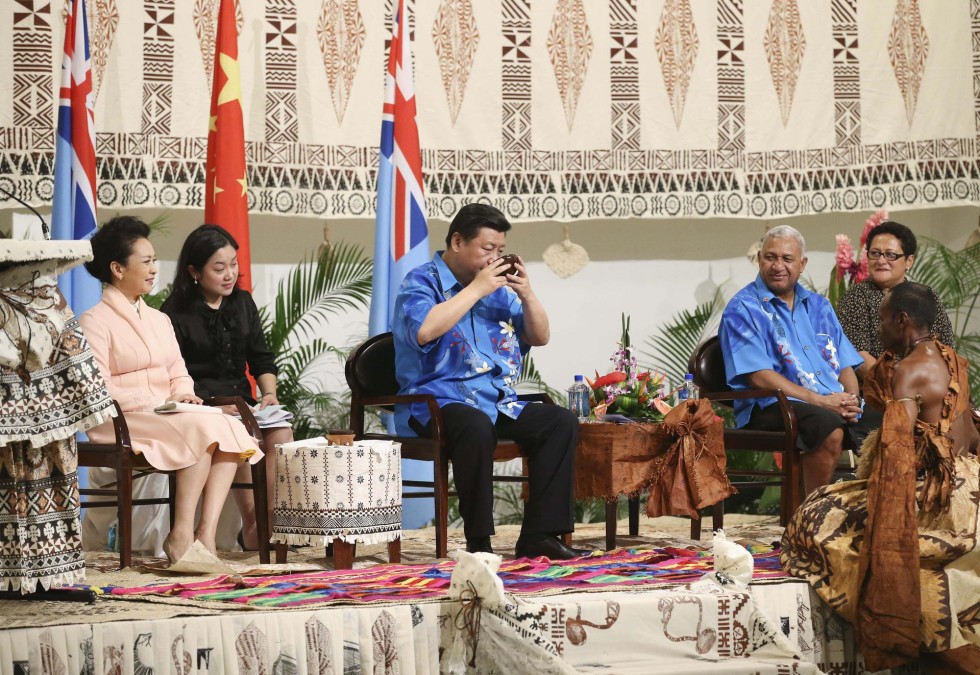
China appreciates Fiji's efforts to help the government chase corrupt mainland officials and their illegal assets, President Xi Jinping said during his official visit to the South Pacific nation.
In his meeting with Fijian Prime Minister Frank Bainimarama on Friday in Nadi, Fiji's capital, Xi said Beijing hoped to strengthen bilateral law enforcement cooperation with Fiji, Xinhua reported yesterday.
Xi also pledged China's help to Fiji's developing economy, improving livelihoods and tacking climate change, Xinhua added.
On August 19 last year, Chen Yi , former head of Shanghai's largest insurance agency who allegedly fled with 500 million yuan from the company, was caught in Fiji and escorted back to China by police officers.
International relations experts said Xi's speech and other promises indicated that China would develop closer ties with Fiji. The island nation has a very large Indian community who make 38 per cent of the population and a smaller, mostly Cantonese-speaking Chinese community numbering about 8,000. More recently it has become known as an "overseas paradise" for corrupt Chinese officials.
"Fiji has become one of the most popular destinations for corrupt Chinese officials and fugitives in recent years because the country has many hard-to-reach islands," said Zhou Fangyin , a professor at the Guangdong Research Institute for International Strategies, said.
"Law enforcement in Fiji is very poor due to its imperfect legal system and unstable political situation."
Bainimarama, the former head of the army, has been Prime Minister since he staged a military coup in December 2006. China seized the advantage when Nadi's ties with neighbours Australia, New Zealand, other Pacific forum members and the British Commonwealth soured after the putsch.
Xi's state trip to Nadi is also the first by a Chinese president.
In a meeting his counterpart, President Chief Epeli Nailatikau, Xi said China regarded Fiji as a sincere friend and important partner in the Pacific.
"[China and Fiji] should give play to complementary advantages and lift the level of cooperation," Xinhua cited Xi as saying. "China will continue to support and assist Fiji in dealing with climate change."
It said Xi also promised that China would import more Fijian produce, help it tap China's tourism market and encourage more Chinese investment.
"Xi made many promises to Fiji because all the South Pacific nations have strategic value to China, with each country having a vote at the United Nations, despite their small populations," Zhou said.
Xi arrived in Nadi on early Friday. It is the last stop of his three-nation South Pacific tour that also included New Zealand.
This article appeared in the South China Morning Post print edition as Fiji thanked for graft fight help
Indian Express - Chinese Takeaway: Modi’s Indo-Pacific
Written by C Raja Mohan

The last time an Indian prime minister traveled to Fiji was in 1981, when Indira Gandhi arrived there.
Prime Minister Narendra Modi’s decision to visit Fiji after his pre-scheduled trips to Myanmar and Australia was indeed a surprise. This underlines the new commitment in New Delhi to bridging the gap between the potential and reality of Delhi’s reach in the Indo-Pacific. The last time an Indian prime minister traveled to Fiji was in 1981, when Indira Gandhi arrived there. Since then, much has happened in Fiji and around it. The intensification of ethnic conflict in Fiji between Indian immigrants and the native populations saw Delhi focus exclusively on securing the interests of the diaspora. The many coups in Fiji and the discrimination against the Indian community there led to Delhi’s efforts to isolate the government and lose its broader influence in the island. Modi’s visit comes in the wake of the UPA government’s decision to begin constructive engagement of Fiji a few years ago.
In the island itself, the elections earlier this year saw the strongman Frank Bainimarama shed his military uniform and win a democratic election with the support of ethnic minorities, including sections of the Indian community. If the restoration of democracy in Fiji set a positive context for Modi’s visit, the PM announced a number of steps to boost India’s relationship with Suva. This included the expansion of India’s development partnership with Fiji, improving air links and announcing visa on arrival for the citizens of Fiji.
Fiji Looks North
The diaspora is not the only reason that has taken Modi to Fiji. Long seen as the backwaters of global politics, the region has increasingly become an important theatre in the emerging great power contestation in the Indo-Pacific. As elsewhere, the rapid rise of China and its intensive outreach to the islands in the last few years has stirred other major powers into action. What began initially as a competition with Taiwan for diplomatic recognition among the island states has now acquired an intensive strategic dimension.
With their vast exclusive economic zones, the Pacific Islands occupy millions of square kilometres of ocean space and straddle vital sea lines of communication. Some provide ideal vantage points for military power projection. They are also important locations for gathering signal intelligence and monitoring outer space activity. Guam, for example, is now critical for the maintenance of American forward military presence in the Pacific. The US also tests many of its “star wars” systems in the littoral.
For China, which seeks to expand its own strategic influence in the Pacific, limit American military primacy in the region and gain access to the rich natural resources of the littoral, the Pacific Islands have become an important priority. The last few years have seen China step up its presence through massive aid programmes, civilian as well as military, and frequent deployment of its naval units and the development of maritime infrastructure in the region. China also built a satellite-tracking station in Kiribati which, of course, was dismantled when the island switched its allegiance to Taiwan.
China’s interest has given the islands more strategic options in their international relations and the means to resist political pressures from Australia and New Zealand. Fiji has consciously articulated a “look north” policy and played the China card with considerable deftness. With China raising its profile in the south Pacific, the US has ended its post-Cold War neglect of the islands and is back in play. Japan, too, is now committed to doing more for the islands. Australia and New Zealand, which had a free hand in the region after the Cold War, are now recalibrating their policies.
India Card
Hours after Modi left Fiji, Bainimarama was hosting Chinese President Xi Jinping. Xi is no stranger to the region, having visited the littoral as vice president a few years ago. Fiji and the other islands are eager for a strong Indian presence in the littoral. They know that India can’t match the Chinese, dollar to dollar, in providing economic assistance. The islanders have no desire to switch from a dependence on the West to a total reliance on China. India’s presence offers the prospect of greater regional balance in the south Pacific and offers more economic and political choices to the island states.
In meeting all the leaders of the Pacific Islands, promising to make the joint forum a regular affair, enhancing India’s economic assistance programmes and unveiling defence cooperation with Fiji, Modi has demonstrated that India is ready to turn its historic links with the south Pacific into a strategic partnership.
The writer is a distinguished fellow at the Observer Research Foundation and a contributing editor for ‘The Indian Express’
Posted: November 21, 2014 12:10 am

The last time an Indian prime minister traveled to Fiji was in 1981, when Indira Gandhi arrived there.
Prime Minister Narendra Modi’s decision to visit Fiji after his pre-scheduled trips to Myanmar and Australia was indeed a surprise. This underlines the new commitment in New Delhi to bridging the gap between the potential and reality of Delhi’s reach in the Indo-Pacific. The last time an Indian prime minister traveled to Fiji was in 1981, when Indira Gandhi arrived there. Since then, much has happened in Fiji and around it. The intensification of ethnic conflict in Fiji between Indian immigrants and the native populations saw Delhi focus exclusively on securing the interests of the diaspora. The many coups in Fiji and the discrimination against the Indian community there led to Delhi’s efforts to isolate the government and lose its broader influence in the island. Modi’s visit comes in the wake of the UPA government’s decision to begin constructive engagement of Fiji a few years ago.
In the island itself, the elections earlier this year saw the strongman Frank Bainimarama shed his military uniform and win a democratic election with the support of ethnic minorities, including sections of the Indian community. If the restoration of democracy in Fiji set a positive context for Modi’s visit, the PM announced a number of steps to boost India’s relationship with Suva. This included the expansion of India’s development partnership with Fiji, improving air links and announcing visa on arrival for the citizens of Fiji.
Fiji Looks North
The diaspora is not the only reason that has taken Modi to Fiji. Long seen as the backwaters of global politics, the region has increasingly become an important theatre in the emerging great power contestation in the Indo-Pacific. As elsewhere, the rapid rise of China and its intensive outreach to the islands in the last few years has stirred other major powers into action. What began initially as a competition with Taiwan for diplomatic recognition among the island states has now acquired an intensive strategic dimension.
With their vast exclusive economic zones, the Pacific Islands occupy millions of square kilometres of ocean space and straddle vital sea lines of communication. Some provide ideal vantage points for military power projection. They are also important locations for gathering signal intelligence and monitoring outer space activity. Guam, for example, is now critical for the maintenance of American forward military presence in the Pacific. The US also tests many of its “star wars” systems in the littoral.
For China, which seeks to expand its own strategic influence in the Pacific, limit American military primacy in the region and gain access to the rich natural resources of the littoral, the Pacific Islands have become an important priority. The last few years have seen China step up its presence through massive aid programmes, civilian as well as military, and frequent deployment of its naval units and the development of maritime infrastructure in the region. China also built a satellite-tracking station in Kiribati which, of course, was dismantled when the island switched its allegiance to Taiwan.
China’s interest has given the islands more strategic options in their international relations and the means to resist political pressures from Australia and New Zealand. Fiji has consciously articulated a “look north” policy and played the China card with considerable deftness. With China raising its profile in the south Pacific, the US has ended its post-Cold War neglect of the islands and is back in play. Japan, too, is now committed to doing more for the islands. Australia and New Zealand, which had a free hand in the region after the Cold War, are now recalibrating their policies.
India Card
Hours after Modi left Fiji, Bainimarama was hosting Chinese President Xi Jinping. Xi is no stranger to the region, having visited the littoral as vice president a few years ago. Fiji and the other islands are eager for a strong Indian presence in the littoral. They know that India can’t match the Chinese, dollar to dollar, in providing economic assistance. The islanders have no desire to switch from a dependence on the West to a total reliance on China. India’s presence offers the prospect of greater regional balance in the south Pacific and offers more economic and political choices to the island states.
In meeting all the leaders of the Pacific Islands, promising to make the joint forum a regular affair, enhancing India’s economic assistance programmes and unveiling defence cooperation with Fiji, Modi has demonstrated that India is ready to turn its historic links with the south Pacific into a strategic partnership.
The writer is a distinguished fellow at the Observer Research Foundation and a contributing editor for ‘The Indian Express’
November 23, 2014
The Telegraph India: Fiji mission land-deal niggle for Modi Govt glare on ‘unequal’ swap
Wednesday , November 19 , 2014
K.P. NAYAR
K.P. NAYAR
![]() |
| Prime Minister Narendra Modi and his Australian counterpart Tony Abbott with VVS Laxman, Sunil Gavaskar and Kapil Dev at the Melbourne Cricket Ground on Tuesday. (Reuters) |
Nov. 18: As Narendra Modi’s one-day visit to Fiji gets under way on Wednesday, the Prime Minister will discover that 135 years after the first Indian indentured labourers landed on what is now a popular Pacific honeymoon destination, land is still an issue of contention between New Delhi and Suva, the island’s capital.
At issue since the BJP-led government assumed office is a decision taken by the government of Manmohan Singh without much application of mind to give away a precious plot of land in one of the priciest parts of the capital to Fiji.
The land is earmarked to construct its new high commission building after Suva opened its first diplomatic outpost in South Asia when bilateral ties were mended many years after a military takeover in May 1987 against Indian political domination of the island state.
Such allotments of land are normally done on reciprocity between governments: India has been similarly given a plot of land in Suva for its high commission. The mission was closed in May 1990 by Fiji after expelling the head of mission, T.P. Sreenivasan.
Sreenivasan was asked to leave the island in 72 hours for making an allegedly inflammatory speech in a gurdwara which was burnt and Sikh holy scriptures were vandalised by Fijian ultra-nationalists. The violence against the gurdwara was one of many incidents against Indian immigrants following the coup.
The Modi government’s hesitation in implementing its UPA predecessor’s reciprocal gesture is that land in Chanakyapuri, the prime diplomatic enclave in the capital, is worth many, many crores more than what India is getting in return in Suva, where property prices are a pittance compared to New Delhi.
With a finance minister who is increasingly scrutinising overseas expenses instead of accepting the discretion of the ministry of external affairs, Arun Jaitley’s nominee in South Block on deputation from his ministry feels that the Suva-Delhi deal to build high commissions in each other’s capitals is only doing lip service to reciprocity.
Auditors who annually inspect all Indian missions abroad are also of the view that India has lost hugely on the allotment of land in Chanakyapuri to the Fijians because it is getting much less in exchange in Suva.
Land is also scarce in Chanakyapuri after Jawaharlal Nehru’s decision to give away entire streets as in Shanti Path in the heart of the diplomatic enclave to countries like China and prominent western countries. Nehru was so generous that Sri Lanka declined a portion of the huge parcel of land that it was gifted.
Because there is no more land available in Chanakyapuri, a number of countries born after the end of the Cold War are being exiled to Dwarka where land has been given on a reciprocal basis.
Several other countries that have opened missions in New Delhi more recently following a growing global acknowledgement of India as an emerging power are operating out of rented premises in posh residential areas like Vasant Vihar. They also hope to get land only in faraway Dwarka, near the airport.
Opinion is, therefore, crystallising within the Modi government that if at all any remaining parcels of land are to be given in Chanakyapuri, it should not be for Fiji. Instead, India could negotiate reciprocity in pricey European capitals, where its missions are on rented premises, and thus save millions of euros through hard bargaining.
It is not clear if the issue will come up at the highest level in today’s talks in Suva. Discretion on both sides may let the issue be discussed at official levels instead. But reciprocity in land allotment will be the elephant in the summit hall when Modi meets Fiji’s top leaders.
The issue will be a reminder to Modi that ever since 1879, when the first Indian labourer arrived in Fiji, land has been an issue between the two countries. Fiji’s constitution, which came into force in 1970, affirmed that native land was inalienable and Indians, even after generations, could only get long leases, not own it.
On the happier side of his visit, Modi will have the satisfaction of making a new beginning with Fiji not with ghosts from the past but after burying a distasteful bilateral baggage of many decades. Here, help from his native Gujarat, although unplanned and fortuitous, has come in handy.
In 2007, the young colonel who launched the anti-Indian coup, Sitiveni Rabuka, travelled to Gujarat. Of all the places in the world, even though Fiji’s government would have footed his medical bills anywhere in the world, Rabuka reached out to Bharat Mody, the well known anthroplasty surgeon in Vadodara who is known to the Prime Minister, to perform knee replacement surgery on him.
Inevitably, Rabuka’s choice of India, reckoned till then as the raison d’etre for an audacious coup, made news all over the Pacific, in Australia and in New Zealand. Gujarat benefited immensely.
A statement attributed to surgeon Mody on the website of Vadodara’s Welcare Hospital, where he is chief of the centre for knee surgery, at that time said: “Prime Minister Rabuka’s visit to Vadodara will give an overall boost to the city’s medical tourism. People will now turn to Vadodara for other medical treatments along with knee problems. And this is just the beginning.”
It is not certain at the time of writing if Modi’s path in Fiji will cross that of Rabuka. Sreenivasan’s judgement is that Rabuka “overthrew a democratically elected government, discriminated against the Fiji Indians, brought untold humiliation and suffering on them, tried to disenfranchise them, ordered me out of Fiji and closed down the Indian high commission.”
But these two men made peace in April this year. Sreenivasan was invited back to Fiji almost 25 years after his expulsion. They sat on the same chairs in the Suva Golf Club where they had their first conversation when Rabuka was a mere colonel and Sreenivasan was on the threshold of becoming a joint secretary.
That gesture made it easier for South Block to work on the Prime Minister’s visit. Rabuka told Sreenivasan that after the surgery in Vadodara, his “quality of life had improved”. Few things could please Modi more than that remorseful acknowledgement from someone who was once against Indians.
November 19, 2014
Prof Wadan Narsey: MIDA Chairman changes his tune
19 Nov. 2014
The Media Industry Development Authority was established by the Bainimarama Government in 2010, supposedly to regulate the media industry for the public good.
Yet MIDA’s ready condemnation of journalists from Fiji, ABC and NZRI for alleged biases (read here), its ready condemnation of local media for running alleged “hate speeches” (read here), and its reluctance to subject the Bainimarama Government to the same scrutiny (read here), might suggest that MIDA is being used more to regulate the media in the interests of the Bainimarama Government,
When the current MIDA Chairman (Ashwin Raj) was appointed, he announced his intention to tackle media censorship on a principled basis, and immediately demanded accountability from the media on their editorial policies for opinion articles and Letters to the Editor.
Much of the content of the censored articles and letters to the editor, could have influenced voters in the September 2014 elections.
Following the September 2014 elections and the victory of Fiji First Party (FFP) and Bainimarama, however, there has been a complete reversal in attitude of the MIDA Chairman.
The MIDA Chairman seems to suffer amnesia of the last six years history of the Fiji media being intimidated by the Bainimarama Government, and its biased treatment of different media.
The MIDA Chairman is currently achieving international prominence and status in the defense of the Bainimarama Government on its record on human rights.
It is quite unlikely that the MIDA Chairman will play any significant part in bringing about greater media freedom, and a level playing field for all media interests.
This article is based on my personal experience.
The media censorship and MIDA
From 2009, with the Bainimarama Government tightening its media censorship, Fiji’s print media stopped publishing my critical articles and opinion pieces on public policy matters.
I resorted to writing Letters to the Editor, but found that even these were being censored (see this page on my personal blog, Narsey On Fiji for evidence).
One after another, two professors of literature (Satendra Nandan and Subramani) were appointed as Chairmen of MIDA, only to distinguish themselves by their calculated silence on the ongoing media censorship.
I was more hopeful when an articulate USP administrator, Ashwin Raj, was appointed Chairman of MIDA and I began cc’ing him my Letters to the Editor so that he could see, at first hand, the censorship that was being practiced.
Apparently sympathetic, the MIDA Chairman asked the media to reveal their editorial policies on their decisions to publish or not publish opinion pieces and Letters to the Editor.
With no response from the media, I addressed specific queries to the MIDA Chairman outlining the factors undermining the even development of the media industry (letter of 3 July 2014, edited here for space):
Dear Mr Raj
1. Earlier in the year, you gave a commitment at the World Press Freedom Day panel that you had written to the editors of the newspapers, seeking clarification of their policies on what letters to publish and not.
(a) Could you please tell the public what has been their response and whether MIDA is comfortable with their position.
(b) Could you also please ask all the television and radio stations what their policy is on interviewing experts on public policy issues in various fields (for example, the humble field of economics which all political parties, candidates and voters are focused on currently)?
2. As a “level playing field” is an essential part of the development of a free, fair, competitive and transparent media industry, could you please inform the public what is your position on:
(a) taxpayers advertisement funds being channelled by the Bainimarama Government only to Fiji Sun with The Fiji Times, the oldest Fijian newspaper, being totally denied
(b) outright subsidies given to FBC via government budget and government guarantees of loans from FDB, with no such subsidies given to either Fiji TV or the other radio broadcasters, Communications Fiji Ltd.
(c) the clearly intimidating renewal of the license for Fiji TV on a six monthly basis, while FBC TV suffers from no such restriction
(d) While Fiji TV’s accounts are available to the shareholders, FBC accounts are not available at all to the taxpayers who supposedly own FBC.
(e) Mai TV’s “scoop” at obtaining rights to the broadcast of FIFA World Cup (a legitimate entrepreneurial transaction admired in the business world) being forcibly shared by decree amongst the other broadcasters, on financial terms dictated by the Bainimarama Government rather than negotiated amongst themselves as a market transaction.
3. Given that you (and the PS Ministry of Information Sharon Smith Johns) have often publicly admonished journalists to be “robust” and “boldly investigative” in their work, did you query Fiji TV and the owners Fijian Holdings Limited why respected senior journalist and administrator Mr Anish Chand was sacked from Fiji TV on this year’s World Press Freedom day, because of complaints from the Bainimarama Government (as was related to you during the World Press Freedom Day panel at USP).
Yours sincerely
Professor Wadan Narsey
There was no response from the MIDA Chairman.
Another letter to the MIDA Chairman (and the editors of the print media) on 16 July 2014 asked again why the print media were not publishing my Letters to the Editor which were calling on the Bainimarama Government to reveal the salaries of ministers between 2010 and 2013, and why the Bainimarama Government was not releasing the Auditor General’s Reports from 2007 to 2013. Both issues were of importance in the elections.
Ashwin Raj then cc’d to me a 19 July 2014 letter he wrote to Matai Akauola (CEO of MIDA).
Dear Matai,
You will attest to the fact that on several occasions, I have requested the mainstream media to disclose their in-house editorial policy.
In the interest of transparency, the public should know exactly the rationale behind the publishing of select articles, opinion pieces, letters to the editor, to the exclusion of others. ….
the onus is really on the media to substantiate their claim that they have in place an in-house editorial policy that ensures that the media is balanced, that they are committed to ensuring access and equity and are transparent at all times…..
to date, I have received nothing from the media houses. I am now requiring the media to disclose this.
Appreciate it if you can circulate this e mail to the media. Can we convene an editors’ roundtable soon please?
Regards, Ashwin.
The media still did not respond.
I sent another letter to the MIDA Chairman on 27 July 2014, and also to the print media as Letter to Editor, reminding him that he had not replied to my previous queries.
On the 28 July, the MIDA Chairman, clearly irritated by now, replied:
“While I acknowledge your contribution to public discourse on matters germane to national interest, it is imperative that I am not openly (or otherwise) copied in the quotidian nature your correspondence with the media. …. this act of openly copying me each time you request the media to publish your letters and opinion pieces can be construed as an act of coercion.”
But he reiterated that he was still pursuing the media for their editorial policy.
“You might also be aware from my press conference this week that I am requiring all media outlets to disclose their in-house editorial policy. The public or any other concerned entity has the right to know why some letters, articles and opinion pieces get published to the exclusion of others.”
Just prior to the elections I sent another letter on 20 August 2014 to the MIDA Chairman pointing out that with just a month to go to the elections, the evidence indicated that the media journalists who were interviewing political candidates, and MIDA itself did not appear to be neutral.
One Fiji Broadcasting Corporation journalist, Veena Bhatnagar, soon after showing her pro-Bainimarama bias when hosting an FBC hosted debate between two political candidates (Professor Biman Prasad of NFP and Aiyaz Khaiyum of FFP), became a candidate for FFP. So also did the MIDA Chairman (Matai Akauola) become a candidate for FFP.
I asked the MIDA Chairman to explain when exactly his CEO began discussions with the FFP to stand as their candidate, and to ask the FBC CEO (Riyaz Khaiyum) when he was informed by his journalist Veena Bhatnagar that she was having discussions with Fiji First Party to stand as a candidate for them.
There was no reply from the MIDA Chairman.
The September 2014 Elections took place, Bainimarama was appointed as a democratically elected Prime Minister.
The MIDA Chairman then replied on 27 October 2014 with a clear reversal of attitude:
“Please note that the media has the freedom to publish and can equally exercise their right not to publish your letter and MIDA will not interfere in this process. Should you feel that there is a systemic exclusion of your letters, please lodge an official complaint with MIDA”.
How extraordinary that a MIDA Chairman who comes out all guns blazing at a call from Bainimarama, ignores a complaint in an email, and demands a “formal complaint” before he will take action.
The MIDA Chairman also declines to be proactive about the refusal of the Fiji Sun to publish a Letter to the Editor complaining about an attack on me by its journalist Jyoti Pratibha, thereby breaching one of the fundamental principles of media freedom - that correspondents should be given a right to reply to attacks by the media.
The MIDA Chairman and media intimidation
The MIDA Chairman, who easily remembers the wrong doings of British colonialism in Fiji a hundred years, has not been able to take heed of all the intimidation of the Fiji media over the last six years (which largely explains the self-censorship that is taking place currently) and which the public easily forgets as well.
In February 2008, Fiji Sun publisher, Russel Hunter was deported in the middle of the night, despite a High Court injunction against the deportation. The Bainimarama Government ridiculously claimed that “Mr Hunter was conducting himself in a manner prejudicial to the peace, defence, public safety, public order, security and stability of the sovereign state of the Fiji Islands.” The facts indicate otherwise.
Russel Hunter stated that he was deported because the Fiji Sun published articles by brilliant investigative journalist, Victor Lal, on the interim Finance Minister’s failure to pay his taxes on time and maintaining large secret bank accounts overseas. The Finance Minister then was Mahendra Chaudhry who was recently convicted by the Bainimarama Government on other charges relating to the same bank accounts. Does the MIDA Chairman Ashwin Raj see as relevant to the current media climate that both Victor Lal and Russel Hunter remain prohibited immigrants from Fiji, essentially for revealing the truth as dedicated investigative and analytical journalists that Aiyaz Khaiyum claimed to want all journalists to be?
In May 2008, Fiji Times published Evan Hannah was deported as was his successor, Rex Gardner, in 2009.
In 2010, outspoken editor of Fiji Times (Netani Rika) and Deputy Editor (Sophie Foster) resigned, “in the interests of the newspaper”, when their “crime” was that their principled refusal to formally recognize an illegal government which had taken power using a military coup.
In 2013, the Fiji Times was fined $300,000, publisher Brian O’Flaherty received a six months suspended sentence, and its Editor, Fred Wesley given a two year suspended jail sentence (running out in February 2015) for the republishing of a NZ media item that would not be considered a crime in Australia or NZ.
Does the MIDA Chairman care at all that the media and the journalists have been intimidated, and that he has a serious role to play in protecting the media and journalists so that they can be the responsible watchdogs on governments they should be?
To understand Ashwin Raj’s back-down from his earlier position, it is useful to understand his meteoric rise to power during the Bainimarama reign, both at USP and nationally.
The rise and rise of Ashwin Raj
Just four years ago, Ashwin Raj was a temporary junior staff member at The University of the South Pacific, struggling to find a foothold as a permanent academic. With a remarkable ability to recognize and fill intellectual power vacuums, Raj soon rapidly rose in status there.
He also made powerful connections with the Bainimarama Regime and was appointed Chairman of MIDA.
He has not criticized the USP management for curbing academic freedom by removing a speaker from a USP program on World Press Freedom Day nor criticized them for the lack of academic debate at USP on matters of good governance.
The MIDA Chairman has just been part of a large team led to Geneva by the Attorney General to present to the UN, the Fiji Government defense on human rights, including media freedom.
In Geneva, the MIDA Chairman did not raise the many issues of media freedom, media censorship and lack of a level playing field for media companies, that have all been publicly raised with him as Chairman of MIDA, nor did he give any hint of his attempt and failure to obtain the editorial policy accountability he has publicly demanded from the media.
Instead, Raj helped to put a gloss on the Bainimarama record on human rights and media freedom, while berating the international donors and international media for their alleged “neo-colonial” practices, as he has done quite frequently.
As the correspondence above indicates, the MIDA Chairman now refuses to be proactively tackle media censorship, government discrimination against some media in the use of tax-payers funds , penalization of critical journalists, the political bias and lack of objectivity of some media and their journalists, and the state’s intimidation of the media through fines, jail terms and insecurity of business licenses.
All these areas ought to be of central concern to a MIDA Chairman whose official remit it is to regulate the media industry in the public good.
The MIDA Chairman is silent on the current failure of some media to inform the public about the damaging contents of the Auditor General Reports from 2007 to 2013, shrewdly released by the Bainimarama Government after the elections, and whose contents clearly substantiate many of the concerns raised by Opposition parties, and critical Letters to the Editor, all censored by the media.
Ashwin Raj is yet another in a long line of intellectuals who have materialized in post-2006 coup Fiji, to fill the propaganda power vacuum in the service of the Bainimarama Government. The public can only wait with bated breath (and a dictionary in hand) to see what further powerful roles he will enjoy in today’s Fiji, which is little different from the military dictatorship we have had for eight years.
Postscript
The Bainimarama Government is apparently in the process of ensuring complete control of the television media in Fiji by quietly designing and forcing a transition from analog TV to digital TV, in which the final outcome will be virtual control by Fiji Broadcasting Corporation and the total subservience of the other media companies.
Subscribe to:
Posts (Atom)