Posted at 17:15 on 19 December, 2011 UTC
The Office of the High Commissioner for Human Rights in the Pacific region has offered to help the Fiji interim government with fulfilling commitments it made in Geneva last year.
Fiji accepted 97 out of 103 recommendations in a United Nations human rights review of the country, including lifting the Public Emergency Regulations.
The Office’s Pacific representative, Matilda Bogner, says Fiji is yet to lift the emergency regulations and stop its human rights abuses.
“We’ve offered to support them to set up a working group to look at what progress has been made so far and meant to coordinate both government and non-government in Fiji to make further progress on those commitments.”
Matilda Bogner says her office has also offered to assist Fiji with ratifying all core human rights treaties.

- INTELLIGENT RESISTANCE -
Free. Fair. Fearless. Intelligentsiya is made up of Fiji Islanders who are libertarians in their own way and who cherish the free flow of news, ideas and information and will peacefully resist any attempts by the country's military rulers to stifle free speech. intelligentsiya will also bear witness, report and discuss human rights abuses by the authorities.
December 20, 2011


Dr Wadan Narsey: Inaccurate News On Fiji Life Expectancies
11:09 December 19, 2011
By Dr Wadan Narsey
Fiji’s media (Fiji Times, Fiji Live) quoted a recent Fiji Islands Health System Review by the Asia Pacific Observatory on Health Systems and Polices (authored by Dr Graham Roberts and Fiji National University) that Fiji’s Life Expectancy had “declined from 72.9 years to 67.8 years from the year 2000 to 2005”- a very large five year drop!
The story was picked up by Pacific Beat of Radio Australia in an interview given by Dr Roberts, and also run by regional news organisations like PINA.
Life expectancies falling by 5 years within a 5 year period would be shocking news for any country, if it were true. But it is fortunately not true for Fiji.
Such misleading media interpretations of available data have to be corrected.
If such statements are later shown to be blatantly wrong (as they are), then as with the boy too often crying “wolf”, the public can be desensitized to what is really a very serious development problem for Fiji- that life expectancies are stagnating and may even be declining for some ethnic and gender groups.
Severe discrepancies in data
“Life expectancies at birth” are composite statistics based on rates of mortalities at all the different age groups- usually grouped into infant mortality, child mortality, and adult mortality.
Life expectancies at birth cannot decline dramatically by 5 years within 5 years unless something absolutely catastrophic is happening (like raging AIDS epidemics).
It would seem that the Graham Roberts/FNU study quoted a dubious Ministry of Health statement in its 2005 Annual Report, and the media pounced on this rather than the other many sensible messages in that Report.
However, a most recent paper published by Dr Karen Carter and others (academics at the University of Sydney and Fiji Ministry of Health officials) in theAustralian and NZ Journal of Public Health, points out the many serious discrepancies in life expectancy estimates for Fiji.
The paper argues that many reports on Fiji’s life expectancy values (including some by the Fiji Ministry of Health) have not been based on sound methodology, and show great unrealistic variation.
When the Carter study “filtered” out all the unreliable reports, they were left with estimates that indicate that since the late 1980s, life expectancies in Fiji have been stagnating at 64 years for males, and 69 years for females.
Such results have been known in Fiji since the 1996 census results came out (see my Fiji Times article of 21 January 2001 “Till death do us part”).
Such results have been known in Fiji since the 1996 census results came out (see my Fiji Times article of 21 January 2001 “Till death do us part”).
Based on sound methodology, this latest paper by Carter and others confirm the bad news that the stagnation in Fiji life expectancies has continued to as recently as 2005, and possibly, beyond.
But nowhere do they imply that life expectancies in Fiji have fallen by five years from the high figure of 72.9 years, as the media has recently publicized.
Media misled
It would be a pity if the international media run with a story like this, inaccurately imputing this to be one of the damaging impacts of the Bainimarama 2006 coup.
For instance, the ABC Pacific Beat interview with Dr Graham Roberts focused very much on the possible impact on life expectancies of military coups (by implication also the Bainimarama coup), with Dr Roberts emphasizing all the resulting hardships and increasing poverty and stresses in life.
Dr Roberts in his ABC interview rightly focused on the impact of modern diets and non-communicable diseases like diabetes and heart disease. Dr Roberts also told Radio Australia’s Pacific Beat that no single factor can be blamed for the dramatic fall. “It’s the fact there’s been multiple transitions going on,” Professor Roberts said.
“We’ve got urbanisation, we’ve got changes in dietary patterns, we’ve got political instability. We’ve got large proportions of the population moving into poverty, we’ve got a significant proportion of the population living in squatter settlements with inadequate water and sanitation. And these are symptoms, once again, [of] the hard times.”
All correct. These impacts are well documented not just in Fiji but elsewhere in the world. And of course, military coups can have an impact on life expectancies through these factors.
Except that the actuaql impacts of military coups on life expectancies have yet to be scientifically quantified.
And there is definitely no credible evidence of Fiji’s life expectancy falling from “72.9 years in 2000 to 67.8 years in 2005”.
The study by Dr Carter and others made no statement about the impact of the 2006 Bainimarama coup on life expectancies over the last five years.
The only reliable numbers suggest that there has been a disturbing stagnation of life expectancies in Fiji, and the possibility of decline amongst some vulnerable groups.
This can be seen in the graph here, based on World Bank data.
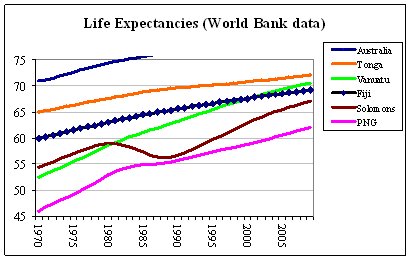
Interesting questions are posed for demographers. Why has Tonga’s life expectancy, which has been much higher than Fiji and other Pacific countries, been leveling off in recent years?
The graphs for PNG and Solomon Islands (the bottom two graphs) are extremely disturbing, and hopefully partly a statistical problem. But are they also indicative of the political and economic instability that these two countries have gone through?
Why is it that life expectancy in Vanuatu, in contrast to other Melanesian countries, indicates a slow but steady growth, now surpassing Fiji? Is it a coincidence that Vanuatu has enjoyed reasonably good health policies and stable governments?
Let us hope that Fiji’s 2007 Census results, long overdue, can reveal more accurate information on the latest developments in life expectancies amongst Fiji’s groups, and more scientific studies that can separate out the impacts of various factors, including perhaps, the impact of coups.
Until then, the media should correct the false impressions created by the recent incredible story that Fiji’s life expectancy has dropped by 5 years in 5 years. That is not the case.
ENDS
December 19, 2011
Michael Field: Twittering Fiji's coup
The first big dividend has come to the people of Fiji thanks to their $1 million donation to Washington
Yes, for all that money, which might have been wasted on schools or hospitals, military, military strongman Voreqe Bainimarama and side-kick Aiyaz Sayed-Khaiyum are now in Twitter space.
And here is a neat thing; Twitter is very democratic and it lets anybody see not only how many both men have – but also who they are and who they are watching.
In the race for victory Bainimarama, who claims to be @FijiPM has 71 followers and he is following 21 people.
Aiyaz, touting himself as @FijiAG has sent out more tweets, but only has 47 followers and follows 20 people.
I’ve listed all the followers and who is being followed, as of December 18, 2011, at the bottom.
Bainimarama’s first target to follow was Aiyaz – you would, wouldn’t you?
Next up is Alec Ross, an innovation advisor for the US
His forth target is Fiji Rugby – they had such a great success at RWC he is no doubt following that.
Bainimarama is also following the UN, the US State Department and the Google Travel Team. It has also clicked the Follow button on the White House, World Wildlife Fund, the British Commonwealth Office and Australian Prime Minister Julia Gillard.
In a romantic moment, he is also following the British Monarchy.
Bainimarama followers include Australian Prime Minister Julia Gillard – or some one purporting to be her.
Then there is Juris Gulbis, apparently the ambassador to Abkhazia in the Asia Pacific region.
That will be to do with this story on the site.
A number of journalists – including this one – are followers, as is one Amit Chand who says he is CEO for Defence Logistics and “senior vice president” for Nadroga Soccer Association.
Right. One Jay Veena Inoca says on her listing “Google me, you’ll find nothing.” That just changed.
Aiyaz has no interesting followers – other than Bainimarama and Gillard.
What is intriguing though is how the two men have set up their accounts for people to follow.
They obviously did not; it Qorvis has pre-selected that the two men are to follow.
But, there is one marvellous difference – just One.
Bainimarama follows Aiyaz and it was his first choice – Aiyaz does not follow Bainimarama.
Wonder why?
Followers of Bainimarama:
mshameer48 Mohammed Shameer
teca58 teca
TuisabetoF Tuisabeto Filipe
CristianoTazmal Mohammed Tajmal
jayveenainoca Jay Vee En
KarynFiji Karyn Blenkiron
patrishachand patrisha chand
motuhawarrior Lea Lani Kauvaka
libertyofba Navi Bola
educationmatter educationmatter
bhavinm Bhavin Marvadi
faraazbaitul Faraaz Baitul Khan
IslesOfSmiles Hosanna Kabakoro
namasaubafiji Anil Krishna
uchandra99 Umesh Chandra
alpenb aldo penbrook
Whaleoil Whaleoil
PremCharan1 Prem Charan
sanjeshnis Sanjeshni
RNasiko repeka nasiko
Kate_Arnott Kate Arnott
rakshays rakshay singh
paradigmwastrel Neil Ashdown
hawleyrose Amanda Rose
meganjwhelan Megan Whelan
fijibook FijiBook
nottiboyee Rahul Singh
ShafeelAhmed Shafeel Ahmed
JoytikaS Joytika Singh
raj_jagendra Raj
gurusan1 Peter Sullivan
lsharmafiji lolesh sharma
amitchnd Amit Chand
AndhyBlake Andhy Blake
kclose85 Kirstie Close
Loxzsen Loraaaaa...
CarolATaylor1 Carol A Taylor
FijiRepublic Republic of Fiji
mereanigonedua mereani gonedua
KenKatafono Kenneth Katafono
SOWANI1 SOWANI
Jeexji Sanjeet Prasad
opfdn Operation Foundation
fijdog F1J1
shavdon Shav Neel Don
ArehWah Areh Wah
vinchetty Vin Chetty
Alifereti Alifereti
natlmac Natalie Macgregor
shanehussein Shane Hussein
Velaerma Velaerma Uerdauv
tqarau Telu Qarau
ferozkhalil Feroz Khalil
LadySekoula Emele Vakatora
FjBlackOrchid Mich Wilson
SadhnaChand Sadhna
LouisMcGoon Louis McGoon
Shaunzak Shaun Kumar
keljnr Kelvin Anthony
LitiaLa Litia La
rubberwilly Debbie Raiwalui
VijayNarayan4 Vijay Narayan
dtabureguci Dionisia Tabureguci
leansalt Lean Salt
JuliaGillard Julia Gillard
JoePfeiff Joe Pfeiff
AnnemarieCoach Annemarie Cross
jgulbis Juris Gulbis
MonsterGrowl Green Monster
kevs4jc Kevs Tavainavesi
mjfield mjfield
chapel8 chapel at eight
Aiyaz Sayed-Khaiyum followers:
trees4fijians Jale O. Baba
DeaShandera Dea Shandera
bhavinm Bhavin Marvadi
faraazbaitul Faraaz Baitul Khan
IslesOfSmiles Hosanna Kabakoro
namasaubafiji Anil Krishna
uchandra99 Umesh Chandra
sanjeshnis Sanjeshni
paradigmwastrel Neil Ashdown
S_R_Productions Spirit Rising Prod.
RNasiko repeka nasiko
Kate_Arnott Kate Arnott
rakshays rakshay singh
fijibook FijiBook
nottiboyee Rahul Singh
RichardRounds Richard Rounds
ShafeelAhmed Shafeel Ahmed
AndhyBlake Andhy Blake
gurusan1 Peter Sullivan
lsharmafiji lolesh sharma
Lovemel9 Zeba ali
meganjwhelan Megan Whelan
mohitkapadia Mohit Kapadia
FijiRepublic Republic of Fiji
FijiPM CDRE JV Bainimarama
mereanigonedua mereani gonedua
kerberusfiji Ben Ralogaivau
shavdon Shav Neel Don
vinchetty Vin Chetty
BruceHillMelb Bruce Hill
RAPacificBeat RA Pacific Beat
Alifereti Alifereti
FijiGovernment Fiji Government
natlmac Natalie Macgregor
Geropb Geraldine Coutts
ferozkhalil Feroz Khalil
mjfield mjfield
VijayNarayan4 Vijay Narayan
SterlingGate Sterling Gate Books
go_fiji_go Brenda Ragi
AnnemarieCoach Annemarie Cross
plutarch88 biri kuruvoli
MonsterGrowl Green Monster
chapel8 chapel at eight
shanehussein Shane Hussein
JuliaGillard Julia Gillard
USRealityCheck US Reality Check
18 December 2011
December 15, 2011
Radio Australia: Non-state groups likely to pressure Fiji in future
Updated December 14, 2011 17:15:24
A Fiji academic in Australia says this week's confrontation between the interim Fiji government and a trade union delegation from Australia and New Zealand is a sign of things to come.
Dr Brij Lal from the Australian National University in Canberra, who co-authored Fiji's 1997 constitution, says non-stage groups are likely to bring more international pressure on the coup installed military governments.
He says there are likely to be more such showdowns between the Fiji interim government and international organisations in future.
Presenter:Bruce Hill
Speaker:Dr Brij Lal, Fiji academic, Australian National University
Listen here.
A Fiji academic in Australia says this week's confrontation between the interim Fiji government and a trade union delegation from Australia and New Zealand is a sign of things to come.
Dr Brij Lal from the Australian National University in Canberra, who co-authored Fiji's 1997 constitution, says non-stage groups are likely to bring more international pressure on the coup installed military governments.
He says there are likely to be more such showdowns between the Fiji interim government and international organisations in future.
Presenter:Bruce Hill
Speaker:Dr Brij Lal, Fiji academic, Australian National University
Listen here.
Subscribe to:
Posts (Atom)