December 23, 2011

Military regime gambles Fiji's future away

Intelligentsiya has not forgotten who the people of Fiji should hold responsible for pushing for gambling/casino in this country.

Meanwhile the illegal and treasonous military regime go all gaga over gambling ventures being touted as the next best thing since sliced bread by a supposedly big-time investor, Larry Claunch.

Dec 21 

 PM_at_granting_of_license
The Fijian Government has decided to grant the nation’s first-ever exclusive gaming license to One Hundred Sands, Limited.  
Once commenced, this project will include a $290 million 5 star luxury casino resort located on Denarau Island. 
The first phase of development will see 190 luxury rooms and suites, three restaurants, and a sports grille, with the second phase of development to include added accommodations, nightclub, and other entertainment venues. There will be 500 slot machines and 54 table games in the casino, while the 1500 seat convention centre will feature fully equipped banquet and catering capabilities, and provide ample space to accommodate corporate retreats and conventions, popular entertainers, sporting events, international awards shows, and more. 
“It is important with all new investment projects – both internal and international – that we protect the rights and interests of Fijians, and provide for the prosperity of our nation”, stated Fiji’s Prime Minister Bainimarama at today’s announcement ceremony.  
The Prime Minister added, “[This project] provides a malleable fusion between the Western ideals of casino gaming with the strong cultural virtues of tribal and community life.  This fusion is what we seek…considering our own national pride in, and respect for the value of the unique, yet united cultures present among all Fijians.”  
“This undertaking is a union of both economic and cultural endeavors,” shared Larry Claunch, Chairman of the Board of One Hundred Sands, Limited. “One Hundred Sands has taken care to strategically partner with the Snoqualmie Tribe from Washington state and Seventh Generation LLC, a Native American company with demonstrated excellence establishing new casinos and affiliate entities around the world while maintaining the integrity of the environment, and supplementing – not supplanting – the existing economy.”  
Consistent with the Bainimarama Government’s efforts to bring dynamic investment to its quickly modernising nation, this exclusive gaming license will further invigorate the Fijian economy; produce upwards of 800 jobs for local residents; add another segment to successful tourism industry; and increase Fiji’s capacity to welcome guests to visit the country.  
The groundbreaking for the gaming facilities, new convention centre, and luxury hotel is tentatively set for March of next year. 
The reality back home in the lauded heartland of the "malleable fusion between the Western ideals of casino gaming with the strong cultural virtues of tribal and community life" is very much moulded by ground truths such as the GFC and plain ol' human nature (read: greed). So much so, that other "tribal casinos" all over Washington are no longer being punted on.
Big payoff eluding troubled tribe
Casino Snoqualmie was supposed to launch the tribe's approximately 600 members to long-awaited economic prosperity, but instead it is bringing in only about a quarter of the revenue projected. And the tribe is hobbled in tackling its problems because of internal political turmoil.
By Lynda V. Mapes
Seattle Times staff reporter

The Snoqualmie tribe last November opened a showpiece casino a half-hour from downtown Seattle — and took on $375 million in debt — amid high hopes.
 
The casino was supposed to launch the tribe's approximately 600 members into long-awaited prosperity. Instead, it has been bringing in only about a quarter of the projected revenue to the tribe. 
The tribe, which just regained federal recognition in 1999, has been faced with budget cuts and layoffs, according to a June memo written by Henry Flood, a grant and contract administration consultant, to the tribal council and administrator. 
"The adopted budget for 2009 ... has proved to be wildly inaccurate. Gaming revenue is $250,000 a month instead of $1,000,000 a month," said the memo, obtained by The Seattle Times. "A combination of cutbacks and loan funding is imperative to avoid financial collapse." 
And, for the second time in as many years, the tribe is in political turmoil, too. 
In April 2008, the tribe banished nine of its members, in part over a disputed election the previous May. As a lawsuit slowly worked through the courts, the banishment weighed on the tribe until a federal judge partially overturned it earlier this year. 
And today, as the tribe meets to reconsider that banishment, it also must consider ways to restore its leadership after another falling out. The tribal council, mired in disagreement over the May 2008 elections, was so severely divided it would not meet regularly to conduct business. 
Troubled finances
Flood's memo pointed out a host of problems in need of attention — what he called "The Big Fix" project. He noted unresolved federal audit findings questioning costs dating back to fiscal year 2004 that could potentially exceed $1 million. But until the tribe completes the audits, it can't know what, if any, liability it's facing.
 
The tribe is working with old overhead rates on contracts, which hurts cash flow, Flood noted. He also found the finance office is not staffed to handle the volume and complexity of transactions it sees, and the staff lacks training. 
Flood determined the tribe was not keeping current on reimbursements on some contracts and grants, had advanced "large sums of money" without getting paid back, and that inaccurate record keeping made getting paid more challenging. Flood also found the tribe has "major problems" organizing, tracking and monitoring its awarded contracts and grants, and that financial reports on many grants and contracts are delinquent. 
"The result is inefficiency and confusion, disorganized and lost paperwork, delayed payments, suspensions and negative compliance reviews."

Who's governing?
But the tribe can't tackle The Big Fix without a functioning government — and it's been plagued by infighting.
 
"They were a split council and would not come together for joint meetings off and on since May," said Judy Joseph, superintendent for the Bureau of Indian Affairs (BIA) Puget Sound Agency in Everett. 
"To maintain a government-to-government relationship, they have to be a viable tribal government," Joseph said. "If there is any question about that, it causes red flags to go up, and they were split, they were not meeting." 
In August, the tribe's administrative offices were padlocked and some of its federal funds frozen. Elders stepped in to dissolve the council and take charge until new elections could be held — but they had no constitutional authority to do that. 
Tribal administrator Matt Mattson wrote to tribal staff on Sept. 1, according to an internal e-mail, explaining the tribal council and government "are in turmoil amid an internal rift ... I have closed the tribal center and central records facility to allow all parties to think about their options." 
He called it a "terrible situation" and said the tribe was facing the prospect of the U.S. government assuming administrative control of the tribal government. "This is not in anyone's interest. At the moment that step is not imminent, but it is real and possible," he wrote. He did not return telephone calls from The Times requesting more information. 
The Bureau of Indian Affairs offered mediation this month. Two days of talks at a Seattle law firm — paid for by U.S. taxpayers — resulted in reinstatement of the council that was in place before the disputed May election. 
The tribe's general membership will meet this morning in Monroe. After taking up the banishment question, tribal members also will be asked to consider election procedures and set a date for a new council election. 
Still in business
Through it all, tribal clinics and the casino have continued to function.
 
Susan Arland, spokeswoman for the state Gambling Commission, which licenses Casino Snoqualmie, said the political dispute has not, "to the agency's knowledge," affected the orderly and lawful operation of the casino, so it has not affected the tribe's gambling license. 
Joseph, at the BIA, said her agency stepped in reluctantly. "It is not very often that we have to do this, and it is not a good thing," Joseph said. 
Tribal administrative offices were reopened Sept. 15. Joseph said she also has authorized unfreezing federal funds. 
How lasting the mediation will prove is yet to be seen. "Part of the meeting Saturday is to discuss that very issue, whether they accept the pre-May council as their council," Joseph said. "They could decide they don't go with the mediation. Then who's the council? You are right back where you started." 
It's been a painful chapter. 
"Especially when it comes to a casino tribe, you are walking a thin line there when you have put the money up for a multimillion-dollar casino," said Joseph, a member of the Yakama nation. "There are always people who want to see you fail. A lot of this is new-tribe growing pains." 
Gabriel de los Angeles was elected to the council in May as an alternate. He said his council position is "off in the ether at this point." Angeles, 30, said he was thrilled to go to work for his tribe, bringing a master's degree and a range of experience with nonprofit groups. Now, he doesn't even want to go to the general membership meeting. 
The feuds at tribal government were frustrating, he said. "It has been very difficult, to deal with this thing, it has been so confusing, so back-and-forth — here is a decision, and a protest to that decision, and another protest to the decision. It makes it difficult for anyone to get any work done." 
Lynda V. Mapes: 206-464-2736 or lmapes@seattletimes.com

December 20, 2011

(Sri Lanka) Daily News: Dr. L. M. Jayaratne: legal-lion-heart

And here we have it folks. It will become harder and harder for Qorvis and all their Twittering Twits to keep doing damage control for the illegal and treasonous military regime, for the knock-on effects are too widespread to manage.

For as long as we've cautioned, the Sri Lankan imports (especially in the legal fraternity) have been cause for concern.

It is now crystal clear that the legal imports have themselves been under immense pressure by the regime to rule a certain way.

What is even more interesting is that among Sri Lankans, their influx is causing their own citizens to question the how's and why's.
Tuesday, 20 December 2011 
Justice Jayaratne is a bold one, who has the heart of a lion. He is a man who is outspoken and vocal about his achievements. He began his career as a proctor and became a lawyer, judge, scholar, writer and a Provincial Governor of Sri Lanka in 1994. I think the following poem written by Jayaratne will give the reader an idea of the man. 
"Blessed is the court
Bathed with justice
Virtually called the Temple of Justice
Where none can
Escape the legal hand
When crossed with the
Law of the land"

He was former High Court Judge of Sri Lanka and also for some time served as Justice of High Court of Fiji. Indeed it would be correct to say that Jayaratne received his baptism of fire in Fiji where he ran great personal danger to himself and his wife. Jayaratne heard a certain case in Fiji, where the Attorney General's department accused 18 Fiji- born Indians of a coup against the government. Consequently Jayaratne's car was wrecked.
 
School days
"I heard that case. I did not treat it as a very special case. I considered it a normal murder case or treason case or whatever in the High Court. From the evidence there was no proof of treason, far from it. In my opinion, binding law was enough. Apparently the Army was annoyed because they wanted the charge of treason," said Justice Jayaratne.
 
Jayaratne attended Ahangama Dharmarama College down South and reminisced on his old school days. At that time they used the slate and slate pencil. 
They also went barefooted to school because that was the custom and not because they were not rich. In the third standard he was sent to Mahinda College Galle and then from there to St. Peter's College where he did his Senior School Certificate. 
"I tried to enroll myself to more prestigious schools like Royal College but they rejected me. No problem, I got a place at St. Peter's and after that joined Law School. Nothing spectacular but generally that", said Jayaratne. 
Jayaratne graduated from the University of London with an L.L.B. degree and then joined the Inns of Court, Inner Temple London and passed out as a Barrister and was called to the English Bar in 1969. 
Murder case
"We followed lectures and studied very hard. Finally, you are given four shies. I failed twice. I was also a bit frightened because if you fail the last one you are chucked out but nothing happened like that, but I was in great fear that it could happen to me," added Jayaratne.
 
Jayaratne who started practising as proctor was keen to point out that he was a lawyer who never practised under a senior. "I never had a senior. I never studied under a senior; I was by myself, right from A-Z. I did very well, I think. As a proctor I appeared in the Supreme Court. When I got re-enrolled as an advocate I appeared in many cases and then became a judge and magistrate," stated Jayaratne Jayaratne commenced research for his Ph.D. degree under the guidance of Professor G.L. Peiris , then Professor of Law at the University of Colombo. 
Asked what he recollected about that experience, Jayaratne had this to say: "He was very erudite and knowledgeable. What he imparted rarely escapes your mind. It was very clear and the lectures were to the point. You could easily absorb them and digestion was very easy and uncomplicated," said Jayaratne. Another important occasion in Jayaratne's life was the Sadaam Hussein trial which he attended and was allowed to enter because of his reputation. 
"I didn't attend the full trial, it went on for months. I was keen to see the trial going on at the Hague. The trial was not like it is in a court house where you can sit and watch. The judges sit on the bench and you can see the inside of the court. When the sitting commences, a big screen appears and the court is closed. Outside there are two big television sets and you can see everything that happens inside. Sadaam Hussein looked rather annoyed," explained Jayaratne Jayaratne, when asked about his recollections of any particular case or cases, spoke about the Dickwella murder case which was a sensational murder case because the man involved was a businessman. 
"A prominent bus owner was involved in that murder. There were a string of lawyers to defend him and it was hotly contested. As it was a shooting case the then judge , Justice Gratien wanted to visit the scene because of the angle of firing" elaborated Jayaratne. 
Judicial review
Jayaratne is the author of the book: 'Judicial Review of Commissions of Inquiry' which was published in 1995. In this book, he makes an incisive analysis of Commissions of Inquiry with regard to their utility value, their relations to the rights of the individuals and the extent of their amenability to judicial review. Through his analysis of Commissions of Inquiry in various countries, such as, Great Britain, Canada, Australia, New Zealand, India and the United States of America, he has demonstrated the enlargement of the frontiers of natural justice.
 
We also touched on the domestic side of Jayaratne whose wife passed away recently . "Mine was not a love marriage. It was the normal custom-type approach to marriage. But I must say with great pride and respect that she was very helpful to me with guidance. She was actually a very good lady," said Jayaratne. 
Ishara2982@yahoo.com 

RNZI: Fiji offered help to fulfil promises to end human rights abuses

Posted at 17:15 on 19 December, 2011 UTC


The Office of the High Commissioner for Human Rights in the Pacific region has offered to help the Fiji interim government with fulfilling commitments it made in Geneva last year.

Fiji accepted 97 out of 103 recommendations in a United Nations human rights review of the country, including lifting the Public Emergency Regulations.

The Office’s Pacific representative, Matilda Bogner, says Fiji is yet to lift the emergency regulations and stop its human rights abuses.

“We’ve offered to support them to set up a working group to look at what progress has been made so far and meant to coordinate both government and non-government in Fiji to make further progress on those commitments.”

Matilda Bogner says her office has also offered to assist Fiji with ratifying all core human rights treaties.

Dr Wadan Narsey: Inaccurate News On Fiji Life Expectancies

11:09 December 19, 2011

By Dr Wadan Narsey
Fiji’s media (Fiji Times, Fiji Live) quoted a recent Fiji Islands Health System Review by the Asia Pacific Observatory on Health Systems and Polices (authored by Dr Graham Roberts and Fiji National University) that Fiji’s Life Expectancy had “declined from 72.9 years to 67.8 years from the year 2000 to 2005”- a very large five year drop!
The story was picked up by Pacific Beat of Radio Australia in an interview given by Dr Roberts, and also run by regional news organisations like PINA.
Life expectancies falling by 5 years within a 5 year period would be shocking news for any country, if it were true. But it is fortunately not true for Fiji.
Such misleading media interpretations of available data have to be corrected.
If such statements are later shown to be blatantly wrong (as they are), then as with the boy too often crying “wolf”, the public can be desensitized to what is really a very serious development problem for Fiji- that life expectancies are stagnating and may even be declining for some ethnic and gender groups.
Severe discrepancies in data
“Life expectancies at birth” are composite statistics based on rates of mortalities at all the different age groups- usually grouped into infant mortality, child mortality, and adult mortality.
Life expectancies at birth cannot decline dramatically by 5 years within 5 years unless something absolutely catastrophic is happening (like raging AIDS epidemics).
It would seem that the Graham Roberts/FNU study quoted a dubious Ministry of Health statement in its 2005 Annual Report, and the media pounced on this rather than the other many sensible messages in that Report.
However, a most recent paper published by Dr Karen Carter and others (academics at the University of Sydney and Fiji Ministry of Health officials) in theAustralian and NZ Journal of Public Health, points out the many serious discrepancies in life expectancy estimates for Fiji.
The paper argues that many reports on Fiji’s life expectancy values (including some by the Fiji Ministry of Health) have not been based on sound methodology, and show great unrealistic variation.
When the Carter study “filtered” out all the unreliable reports, they were left with estimates that indicate that since the late 1980s, life expectancies in Fiji have been stagnating at 64 years for males, and 69 years for females.
Such results have been known in Fiji since the 1996 census results came out (see my Fiji Times article of 21 January 2001 “Till death do us part”).
Based on sound methodology, this latest paper by Carter and others confirm the bad news that the stagnation in Fiji life expectancies has continued to as recently as 2005, and possibly, beyond.
But nowhere do they imply that life expectancies in Fiji have fallen by five years from the high figure of 72.9 years, as the media has recently publicized.
Media misled
It would be a pity if the international media run with a story like this, inaccurately imputing this to be one of the damaging impacts of the Bainimarama 2006 coup.
For instance, the ABC Pacific Beat interview with Dr Graham Roberts focused very much on the possible impact on life expectancies of military coups (by implication also the Bainimarama coup), with Dr Roberts emphasizing all the resulting hardships and increasing poverty and stresses in life.
Dr Roberts in his ABC interview rightly focused on the impact of modern diets and non-communicable diseases like diabetes and heart disease. Dr Roberts also told Radio Australia’s Pacific Beat that no single factor can be blamed for the dramatic fall. “It’s the fact there’s been multiple transitions going on,” Professor Roberts said.
“We’ve got urbanisation, we’ve got changes in dietary patterns, we’ve got political instability. We’ve got large proportions of the population moving into poverty, we’ve got a significant proportion of the population living in squatter settlements with inadequate water and sanitation. And these are symptoms, once again, [of] the hard times.”
All correct. These impacts are well documented not just in Fiji but elsewhere in the world. And of course, military coups can have an impact on life expectancies through these factors.
Except that the actuaql impacts of military coups on life expectancies have yet to be scientifically quantified.
And there is definitely no credible evidence of Fiji’s life expectancy falling from “72.9 years in 2000 to 67.8 years in 2005”.
The study by Dr Carter and others made no statement about the impact of the 2006 Bainimarama coup on life expectancies over the last five years.
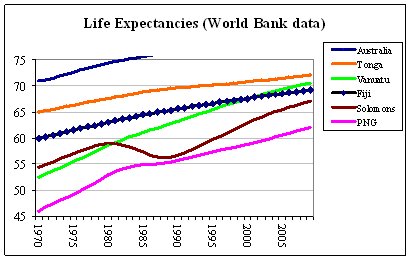
The only reliable numbers suggest that there has been a disturbing stagnation of life expectancies in Fiji, and the possibility of decline amongst some vulnerable groups.
This can be seen in the graph here, based on World Bank data.

Interesting questions are posed for demographers. Why has Tonga’s life expectancy, which has been much higher than Fiji and other Pacific countries, been leveling off in recent years?
The graphs for PNG and Solomon Islands (the bottom two graphs) are extremely disturbing, and hopefully partly a statistical problem. But are they also indicative of the political and economic instability that these two countries have gone through?
Why is it that life expectancy in Vanuatu, in contrast to other Melanesian countries, indicates a slow but steady growth, now surpassing Fiji? Is it a coincidence that Vanuatu has enjoyed reasonably good health policies and stable governments?
Let us hope that Fiji’s 2007 Census results, long overdue, can reveal more accurate information on the latest developments in life expectancies amongst Fiji’s groups, and more scientific studies that can separate out the impacts of various factors, including perhaps, the impact of coups.
Until then, the media should correct the false impressions created by the recent incredible story that Fiji’s life expectancy has dropped by 5 years in 5 years. That is not the case.
ENDS