December 29, 2011

Huffington Post Blog by Anna Lenzer: "Team Fiji" Co-ops the 99%

Anna Lenzer
New York-based journalist
Posted: 12/23/11 09:13 AM ET

The Huffington Post ran a celebratory item last week announcing the Occupy movement's most exotic and far-flung victory yet. In a piece titled and tweeted by HuffPost as "A Win for the 99 Percent," the head of Fiji's military junta and self-appointed Prime Minister, Commodore Voreqe Bainimarama, wrote that "the '99 percent' have called and we have heard them." Bainimarama's inaugural HuffPost blog announced his alignment with the Occupy movement via the promised reduction of taxes on 99% of Fijiian taxpayers, a temporary "Social Responsibility Levy" on the top 1%, as well as a business-friendly climate for foreign investors. He even bothered to respond in the comments section. HuffPost readers could be forgiven for not noticing that the piece was written by an unelected dictator under targeted military sanctions by the United States, who has placed Fiji under martial law and outlawedfreedom of speech, press, assembly, and association. Nothing in the post even hints at Fiji's nightmarish human rights conditions or the writer's status as an international pariah, though his bio does contain his curiously long list of additional titles including also being Fiji's self-appointed Minister for Information and Minister for Finance.
Political dissidents in Fiji are regularly kidnapped by the military and taken to barracks to be beaten or otherwise tortured, where some have died; US Embassy cables released by Wikileaks even detail witness reports that Bainimarama himself beat his critics. Still, the junta leader brazenly declared on HuffPost, "since 2007, my government has enacted critically important political reforms that promote transparency and accountability." In reality, Bainimarama has enforced his rule with a sophisticated surveillance and censorship apparatus through which phone calls and the internet are tightly monitored -- I was arrested in Fiji after the police intercepted my emails, and threatened with rape and indefinite detention. As Minister for Information, Bainimarama has placed government censors in all newsrooms and only allows what the junta has called the "journalism of hope" to be published. Fijians have started dozens of protest blogs detailing the junta's abuses while their media remains censored.
The glowing HuffPost World item certainly appears to be a coup for the DC public relations firm Qorvis Communications, which has been under fire this year for its roster of despotic anti-Arab Spring clients from Bahrain to Yemen to Saudi Arabia. HuffPost itself has done excellent investigative pieces exposing Qorvis' odious clients. The Fijian junta hired Qorvis in early October on a $40,000 per month contract -- the same as its rate for Bahrain -- to burnish the regime's fraying reputation. Fiji's censorship and propaganda-running Ministry of Information announcedthat $1 million Fijian dollars (about $550,000 USD) had been set aside for Qorvis in its 2012 budget. Bainimarama explained in his budget address that Fiji had hired Qorvis "to assist with training and support for our Ministry of Information" on social media and the internet, and that "they will also help coordinate external communications."
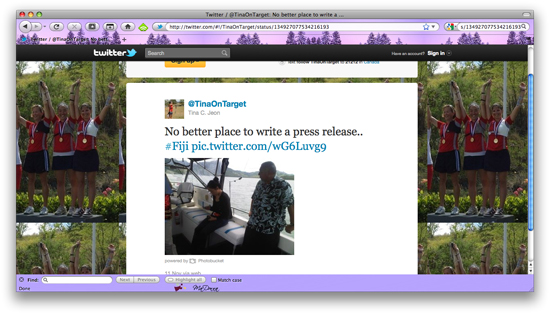
Qorvis director Tina Jeon (whose Twitter bio notes that she's a "Yalie") has issued a series of tweets since the firm's contract began about her time in Fiji, noting her excursions to Bainimarama-led events like the big opening of a Chinese bauxite mine. The most stunning such tweet contains a picture of a young woman sitting on a yacht, typing into a smartphone as Bainimarama stands beside her: "No better place to write a press release.. #Fiji," the tweet reads.
2011-12-22-jijijiijffifij.jpg

Bainimarama's HuffPost debut follows the Fijian junta's exploding internet and social media presence in the weeks since Qorvis began its work: Fiji, Bainimarama, and his draconian decree-drafting Attorney General have since sprouted new websites, Twitter accounts, and YouTube pages, and a steady stream of PR Newswire alerts about the military's excellence have appeared.
Qorvis declined to answer any questions about the work that its "Team Fiji" -- as one Qorvis employee called it -- has done so far. Qorvis partner and former State Department official Matt Lauer told me that "we do not discuss the intricacies of the consulting work we do on behalf of clients," and directed me to the company's Foreign Agent registration for Fiji, which contains no specifics other than boilerplate language about issuing material to the news media. Even though Qorvis was specifically hired to facilitate such news placements and has done so for its other autocratic clients -- such as when the firm placed an article by the President of Sri Lanka in the Philadelphia Inquirer -- HuffPost's blog editor told me that Bainimarama's post came directly from the junta's head office.
"Team Fiji" exemplifies the closed-door work that corporate lobbyists do to promote brutal regimes around the world, at cross-purposes to the State Department's own efforts. Hillary Clintonreferred to Bainimarama's government earlier this year as the "dictatorial regime that unfortunately is now in charge of Fiji," while Qorvis works to give it a makeover and outlets like HuffPost provide it with a global platform on which to spread its propaganda. Qorvis itself, as well as a Qorvis "senior strategist" named Pablo Manriquez who is also a HuffPost blogger, promotedBainimarama's "Win for the 99 Percent" pitch on their own Twitter accounts.
HuffPost Senior Editor Marcus Baram detailed Qorvis' tactics on behalf of other regimes, and explored the firm's unsavory client list, in revealing posts earlier this year. Baram reported that the firm's representation of rogue regimes, especially Middle Eastern autocrats trying to fight off the Arab Spring, was a big reason that more than a third of the firm's partners had quit over a two month period. "I just have trouble working with despotic dictators killing their own people," a former Qorvis insider told HuffPost, adding that "you take a look at the State Department's list of human rights violators and some of our clients were on there."
Harper's contributing editor Ken Silverstein took the Qorvis dissection to the next level earlier this month, when he detailed for Salon what he called this new "meta-lobbying" approach to public relations. Silverstein noted that a Qorvis employee had blogged on HuffPost in defense of the Bahraini regime while his company was retained by it. Qorvis even distributed a statement on the government's behalf blaming Doctors Without Borders for lacking the proper permits after the group was notoriously raided by security forces for treating wounded protesters.
The Fijian junta's cooptation of the 99% meme as it outlaws and brutally punishes any form of protest is a meta-lobbying joke well-played on HuffPost readers. Rather than champion the 99%, as his post claims, Bainimarama has, since seizing power in his 2006 coup, displayed utter contempt for all of the values that the Occupy movement has been fighting for. He has shunned western democracies while accepting hundreds of millions of dollars as well as military aid from China, where he has said that he'd like to see the United Nations moved. Local Fijian councils who don't support the regime just announced that Bainimarama is threatening to withhold money from their regions if they don't fall into line.
Bainimarama's war on the 99% is perhaps best epitomized by his escalating attacks on Fiji's unions and persecution of the country's union leaders, through draconian decrees, denying permits for meetings, detentions and beatings. Last week he denied increasingly alarmed international union observers entry into the country. (New Zealand press reported this week that police were evenpresent against union wishes at a meeting a few days ago in which Fiji Water laid off a third of its workforce.) Union leaders have begged the international community not to give Bainimarama a microphone for his propaganda. In October, the general secretary of an international information, communication and technology union representing more than 3 million workers wrote a letter of protest requesting an emergency meeting with a Swiss conference that had invited Bainimarama to speak: "We protest that the ITU [International Telecommunication Union] is showcasing the leader of an illegitimate regime. A leader who has no democratic mandate but took power by force. Fiji is a country which is acting in fundamental breach of the UN's Human Rights policy and in contradiction to the ILO [International Labour Organization] Core Labour Standards." The letter concluded by noting that "the invitation to the Commodore brings shame on the ITU by giving a public and global platform which he is now using to legitimate his regime."
In the comments section of Bainimarama's HuffPost blog, International Trade Union Confederation General Secretary Sharan Burrow noted that "since Commodore Bainimarama seized power in a 2006 coup, Fiji has been sliding ever closer to absolute dictatorship, and no matter how much the regime invests in public relations, that simple fact remains."

December 28, 2011

Ratu Tevita Mara: Truth For Fiji reveals the truth about the Casino.

Truth For Fiji reveals the truth about the Casino.

The dictator endorsed a pack of lies when he launched the casino with 100 Lies (Oooops! my mistake) Sands Casino Fiji Ltd. Firstly I am going to look at the announcement and explain why it does not add up. Then I am going to reveal the true money grabbing plan revealed to me by a mole inside Aliz Pacific Nur Bano Ali’s corrupt consulting firm.

Larry Claunch announced 100 Sands were going to build a casino, hotel and conference centre costing $290m USD. It was going to have nearly 200 rooms, 500 slot machines and 64 gaming tables. The ground breaking will start in March 2012 and the casino will be finished 18 months later. Larry said they were partnering with Snoqualmie Tribe. The Casino will not be open to locals.

Let’s look at this piece by piece

$290m hotel.
This will make it the most expensive hotel ever built in Fiji. This is nearly $600m Fijian which dwarves the $300m+ FNPF sunk into Natadola. The FNPF as we all know had to write the value of the hotel down to a mere $80m. The most expensive hotel on Denarau cost less than $100m FJD. A hotel costing this much will never make a return on investment even with a casino.

Massive Casino.
The closest casino of a similar size to the one planned by 100 Sands is Sky City in Auckland. But the amount of people that Sky City has to draw on is far bigger. New Zealand has more tourists in a peak month than Fiji has in a whole year. Similarly with Business visitors. Additionally it has the population of Auckland to call on and that is bigger than the total population of Fiji. For those of you who have not visited Sky City the Downstairs is full of the urban poor, mainly Polynesians gambling with their last few dollars. It is not a pretty sight.

So with only the tourists from Denerau and Nadi and a few expats a total of about 7,500 how on earth is Larry going to fill his casino? Obviously he is not. Every punter will have the choice of 3 empty roulette wheels or 100 slot machines to play on. I know why they are calling it 100 Sands: because it is going to be DESERTed.

Larry Claunch
Larry is a man of mystery prior to coming to Fiji. The only thing we really know about him is that he is rich, he has lived in Fiji for about 10 years and he has failed to develop his one property project in Fiji. He has no personal experience of running a casino. One thing he has learnt is that in today’s Fiji it is who you know that matters and he has paid to know the right people as I will show below.

Snoqualmie Tribe.
They borrowed $385m USD in 2007. This money was used to build their first casino. Unfortunately for them it was not a success and actual revenue was one quarter of the projections. They have had to restructure their debt. They are in n position to borrow any more money and what profits they make on their current gambling operations are going to service their existing debt. There is no money for this investment coming from the Snoqualmie Tribe. Their casino expertise only goes back 5 years so they are mere beginners in this complex and difficult business. Added to which their track record is not good and they have had to give their first CEO a payoff of $14mUSD to get rid of him.

These are the experts that Bainimarama has invited into to Fiji to steal from the poorest Fijians. In exchange for what, a nice Indian Chief’s head dress. Most of us grew out of dressing up games when we were kids but Frankie loves dressing up as a builder or an Indian Chief. Just as an aside he has the makings of being a one man Village People.

Not Open to Locals
Larry says the casino will not be open to locals. He then goes on to say he will open a smaller operation in Suva. Last time I looked I could count the number of tourists in Suva on one hand. Larry’s casinos will be open to the Locals.

As you can see this casino operation does not add up and just as worryingly there are no successful casino operators involved.

Now for the real story as revealed from within Aliz Pacific.

I mentioned Larry understood it was all about who you know. Well he hired Aliz Pacific, Dr. Nur Bano Ali’s money laundering consultancy firm. He has paid over $1m in consultancy fees which Aunty Nur shares with her nephew the AG and shares a bit with his puppet. The AG approved the license with Larry and off we go.

However the true plan involves an investment of only a few million and building a new entrance to the upstairs at Port Denerau.

$290m Hotel = Renting upstairs space at Port Denerau.

Larry is building nothing more than a glitzy entrance to the casino that will operate in “office space” above the shops and restaurants of Port Denerau.

Massive Casino = 50 Slot Machines and 7 gaming tables in rented office space in Port Denerau

Larry Claunch = Con Artist who has built nothing in Fiji and has no intention of doing so.

Snoqualmie Tribe = Clincher with the PM.

They will provide no money and no expertise. Just a fancy head dress for little Frankie dressing up cupboard. The irony of the Native Americans selling their land to the white man for a few beads now buying the gambling rights of Fiji for a few feathers and head dress.

Not Open to Locals = Let’s have open house for the locals.

Larry has dressed this up as saying he is totally non discriminatory and he does not feel comfortable not allowing Fijians to enter their own casino. What he means is he can’t wait to get his hands on the local money and make himself rich at our expense.

Overall Larry is going to invest a few million dollars, not build anything and rip off the people of Fiji. There is not $290m USD investment, there will only be a few slot machines flown in.

People of Fiji understand the Dictator is endorsing this scam. Ask yourself why? Is he getting a pay off? Or is he just too stupid to see the real situation? Either way Bainimarama is not fit to run Fiji

Once again we can see the Fijian people are being manipulated by the evil Khaiyum and his wicked witch Aunty Nur Bano Ali.

2012 is the year Fijians will wake up and overthrow dictatorship.

Thumbs up for Democracy!

December 23, 2011

Military regime gambles Fiji's future away

Intelligentsiya has not forgotten who the people of Fiji should hold responsible for pushing for gambling/casino in this country.

Meanwhile the illegal and treasonous military regime go all gaga over gambling ventures being touted as the next best thing since sliced bread by a supposedly big-time investor, Larry Claunch.

Dec 21 

 PM_at_granting_of_license
The Fijian Government has decided to grant the nation’s first-ever exclusive gaming license to One Hundred Sands, Limited.  
Once commenced, this project will include a $290 million 5 star luxury casino resort located on Denarau Island. 
The first phase of development will see 190 luxury rooms and suites, three restaurants, and a sports grille, with the second phase of development to include added accommodations, nightclub, and other entertainment venues. There will be 500 slot machines and 54 table games in the casino, while the 1500 seat convention centre will feature fully equipped banquet and catering capabilities, and provide ample space to accommodate corporate retreats and conventions, popular entertainers, sporting events, international awards shows, and more. 
“It is important with all new investment projects – both internal and international – that we protect the rights and interests of Fijians, and provide for the prosperity of our nation”, stated Fiji’s Prime Minister Bainimarama at today’s announcement ceremony.  
The Prime Minister added, “[This project] provides a malleable fusion between the Western ideals of casino gaming with the strong cultural virtues of tribal and community life.  This fusion is what we seek…considering our own national pride in, and respect for the value of the unique, yet united cultures present among all Fijians.”  
“This undertaking is a union of both economic and cultural endeavors,” shared Larry Claunch, Chairman of the Board of One Hundred Sands, Limited. “One Hundred Sands has taken care to strategically partner with the Snoqualmie Tribe from Washington state and Seventh Generation LLC, a Native American company with demonstrated excellence establishing new casinos and affiliate entities around the world while maintaining the integrity of the environment, and supplementing – not supplanting – the existing economy.”  
Consistent with the Bainimarama Government’s efforts to bring dynamic investment to its quickly modernising nation, this exclusive gaming license will further invigorate the Fijian economy; produce upwards of 800 jobs for local residents; add another segment to successful tourism industry; and increase Fiji’s capacity to welcome guests to visit the country.  
The groundbreaking for the gaming facilities, new convention centre, and luxury hotel is tentatively set for March of next year. 
The reality back home in the lauded heartland of the "malleable fusion between the Western ideals of casino gaming with the strong cultural virtues of tribal and community life" is very much moulded by ground truths such as the GFC and plain ol' human nature (read: greed). So much so, that other "tribal casinos" all over Washington are no longer being punted on.
Big payoff eluding troubled tribe
Casino Snoqualmie was supposed to launch the tribe's approximately 600 members to long-awaited economic prosperity, but instead it is bringing in only about a quarter of the revenue projected. And the tribe is hobbled in tackling its problems because of internal political turmoil.
By Lynda V. Mapes
Seattle Times staff reporter

The Snoqualmie tribe last November opened a showpiece casino a half-hour from downtown Seattle — and took on $375 million in debt — amid high hopes.
 
The casino was supposed to launch the tribe's approximately 600 members into long-awaited prosperity. Instead, it has been bringing in only about a quarter of the projected revenue to the tribe. 
The tribe, which just regained federal recognition in 1999, has been faced with budget cuts and layoffs, according to a June memo written by Henry Flood, a grant and contract administration consultant, to the tribal council and administrator. 
"The adopted budget for 2009 ... has proved to be wildly inaccurate. Gaming revenue is $250,000 a month instead of $1,000,000 a month," said the memo, obtained by The Seattle Times. "A combination of cutbacks and loan funding is imperative to avoid financial collapse." 
And, for the second time in as many years, the tribe is in political turmoil, too. 
In April 2008, the tribe banished nine of its members, in part over a disputed election the previous May. As a lawsuit slowly worked through the courts, the banishment weighed on the tribe until a federal judge partially overturned it earlier this year. 
And today, as the tribe meets to reconsider that banishment, it also must consider ways to restore its leadership after another falling out. The tribal council, mired in disagreement over the May 2008 elections, was so severely divided it would not meet regularly to conduct business. 
Troubled finances
Flood's memo pointed out a host of problems in need of attention — what he called "The Big Fix" project. He noted unresolved federal audit findings questioning costs dating back to fiscal year 2004 that could potentially exceed $1 million. But until the tribe completes the audits, it can't know what, if any, liability it's facing.
 
The tribe is working with old overhead rates on contracts, which hurts cash flow, Flood noted. He also found the finance office is not staffed to handle the volume and complexity of transactions it sees, and the staff lacks training. 
Flood determined the tribe was not keeping current on reimbursements on some contracts and grants, had advanced "large sums of money" without getting paid back, and that inaccurate record keeping made getting paid more challenging. Flood also found the tribe has "major problems" organizing, tracking and monitoring its awarded contracts and grants, and that financial reports on many grants and contracts are delinquent. 
"The result is inefficiency and confusion, disorganized and lost paperwork, delayed payments, suspensions and negative compliance reviews."

Who's governing?
But the tribe can't tackle The Big Fix without a functioning government — and it's been plagued by infighting.
 
"They were a split council and would not come together for joint meetings off and on since May," said Judy Joseph, superintendent for the Bureau of Indian Affairs (BIA) Puget Sound Agency in Everett. 
"To maintain a government-to-government relationship, they have to be a viable tribal government," Joseph said. "If there is any question about that, it causes red flags to go up, and they were split, they were not meeting." 
In August, the tribe's administrative offices were padlocked and some of its federal funds frozen. Elders stepped in to dissolve the council and take charge until new elections could be held — but they had no constitutional authority to do that. 
Tribal administrator Matt Mattson wrote to tribal staff on Sept. 1, according to an internal e-mail, explaining the tribal council and government "are in turmoil amid an internal rift ... I have closed the tribal center and central records facility to allow all parties to think about their options." 
He called it a "terrible situation" and said the tribe was facing the prospect of the U.S. government assuming administrative control of the tribal government. "This is not in anyone's interest. At the moment that step is not imminent, but it is real and possible," he wrote. He did not return telephone calls from The Times requesting more information. 
The Bureau of Indian Affairs offered mediation this month. Two days of talks at a Seattle law firm — paid for by U.S. taxpayers — resulted in reinstatement of the council that was in place before the disputed May election. 
The tribe's general membership will meet this morning in Monroe. After taking up the banishment question, tribal members also will be asked to consider election procedures and set a date for a new council election. 
Still in business
Through it all, tribal clinics and the casino have continued to function.
 
Susan Arland, spokeswoman for the state Gambling Commission, which licenses Casino Snoqualmie, said the political dispute has not, "to the agency's knowledge," affected the orderly and lawful operation of the casino, so it has not affected the tribe's gambling license. 
Joseph, at the BIA, said her agency stepped in reluctantly. "It is not very often that we have to do this, and it is not a good thing," Joseph said. 
Tribal administrative offices were reopened Sept. 15. Joseph said she also has authorized unfreezing federal funds. 
How lasting the mediation will prove is yet to be seen. "Part of the meeting Saturday is to discuss that very issue, whether they accept the pre-May council as their council," Joseph said. "They could decide they don't go with the mediation. Then who's the council? You are right back where you started." 
It's been a painful chapter. 
"Especially when it comes to a casino tribe, you are walking a thin line there when you have put the money up for a multimillion-dollar casino," said Joseph, a member of the Yakama nation. "There are always people who want to see you fail. A lot of this is new-tribe growing pains." 
Gabriel de los Angeles was elected to the council in May as an alternate. He said his council position is "off in the ether at this point." Angeles, 30, said he was thrilled to go to work for his tribe, bringing a master's degree and a range of experience with nonprofit groups. Now, he doesn't even want to go to the general membership meeting. 
The feuds at tribal government were frustrating, he said. "It has been very difficult, to deal with this thing, it has been so confusing, so back-and-forth — here is a decision, and a protest to that decision, and another protest to the decision. It makes it difficult for anyone to get any work done." 
Lynda V. Mapes: 206-464-2736 or lmapes@seattletimes.com

December 20, 2011

(Sri Lanka) Daily News: Dr. L. M. Jayaratne: legal-lion-heart

And here we have it folks. It will become harder and harder for Qorvis and all their Twittering Twits to keep doing damage control for the illegal and treasonous military regime, for the knock-on effects are too widespread to manage.

For as long as we've cautioned, the Sri Lankan imports (especially in the legal fraternity) have been cause for concern.

It is now crystal clear that the legal imports have themselves been under immense pressure by the regime to rule a certain way.

What is even more interesting is that among Sri Lankans, their influx is causing their own citizens to question the how's and why's.
Tuesday, 20 December 2011 
Justice Jayaratne is a bold one, who has the heart of a lion. He is a man who is outspoken and vocal about his achievements. He began his career as a proctor and became a lawyer, judge, scholar, writer and a Provincial Governor of Sri Lanka in 1994. I think the following poem written by Jayaratne will give the reader an idea of the man. 
"Blessed is the court
Bathed with justice
Virtually called the Temple of Justice
Where none can
Escape the legal hand
When crossed with the
Law of the land"

He was former High Court Judge of Sri Lanka and also for some time served as Justice of High Court of Fiji. Indeed it would be correct to say that Jayaratne received his baptism of fire in Fiji where he ran great personal danger to himself and his wife. Jayaratne heard a certain case in Fiji, where the Attorney General's department accused 18 Fiji- born Indians of a coup against the government. Consequently Jayaratne's car was wrecked.
 
School days
"I heard that case. I did not treat it as a very special case. I considered it a normal murder case or treason case or whatever in the High Court. From the evidence there was no proof of treason, far from it. In my opinion, binding law was enough. Apparently the Army was annoyed because they wanted the charge of treason," said Justice Jayaratne.
 
Jayaratne attended Ahangama Dharmarama College down South and reminisced on his old school days. At that time they used the slate and slate pencil. 
They also went barefooted to school because that was the custom and not because they were not rich. In the third standard he was sent to Mahinda College Galle and then from there to St. Peter's College where he did his Senior School Certificate. 
"I tried to enroll myself to more prestigious schools like Royal College but they rejected me. No problem, I got a place at St. Peter's and after that joined Law School. Nothing spectacular but generally that", said Jayaratne. 
Jayaratne graduated from the University of London with an L.L.B. degree and then joined the Inns of Court, Inner Temple London and passed out as a Barrister and was called to the English Bar in 1969. 
Murder case
"We followed lectures and studied very hard. Finally, you are given four shies. I failed twice. I was also a bit frightened because if you fail the last one you are chucked out but nothing happened like that, but I was in great fear that it could happen to me," added Jayaratne.
 
Jayaratne who started practising as proctor was keen to point out that he was a lawyer who never practised under a senior. "I never had a senior. I never studied under a senior; I was by myself, right from A-Z. I did very well, I think. As a proctor I appeared in the Supreme Court. When I got re-enrolled as an advocate I appeared in many cases and then became a judge and magistrate," stated Jayaratne Jayaratne commenced research for his Ph.D. degree under the guidance of Professor G.L. Peiris , then Professor of Law at the University of Colombo. 
Asked what he recollected about that experience, Jayaratne had this to say: "He was very erudite and knowledgeable. What he imparted rarely escapes your mind. It was very clear and the lectures were to the point. You could easily absorb them and digestion was very easy and uncomplicated," said Jayaratne. Another important occasion in Jayaratne's life was the Sadaam Hussein trial which he attended and was allowed to enter because of his reputation. 
"I didn't attend the full trial, it went on for months. I was keen to see the trial going on at the Hague. The trial was not like it is in a court house where you can sit and watch. The judges sit on the bench and you can see the inside of the court. When the sitting commences, a big screen appears and the court is closed. Outside there are two big television sets and you can see everything that happens inside. Sadaam Hussein looked rather annoyed," explained Jayaratne Jayaratne, when asked about his recollections of any particular case or cases, spoke about the Dickwella murder case which was a sensational murder case because the man involved was a businessman. 
"A prominent bus owner was involved in that murder. There were a string of lawyers to defend him and it was hotly contested. As it was a shooting case the then judge , Justice Gratien wanted to visit the scene because of the angle of firing" elaborated Jayaratne. 
Judicial review
Jayaratne is the author of the book: 'Judicial Review of Commissions of Inquiry' which was published in 1995. In this book, he makes an incisive analysis of Commissions of Inquiry with regard to their utility value, their relations to the rights of the individuals and the extent of their amenability to judicial review. Through his analysis of Commissions of Inquiry in various countries, such as, Great Britain, Canada, Australia, New Zealand, India and the United States of America, he has demonstrated the enlargement of the frontiers of natural justice.
 
We also touched on the domestic side of Jayaratne whose wife passed away recently . "Mine was not a love marriage. It was the normal custom-type approach to marriage. But I must say with great pride and respect that she was very helpful to me with guidance. She was actually a very good lady," said Jayaratne. 
Ishara2982@yahoo.com